How overseas brands entering Hong Kong can use Threads to grow brand exposure
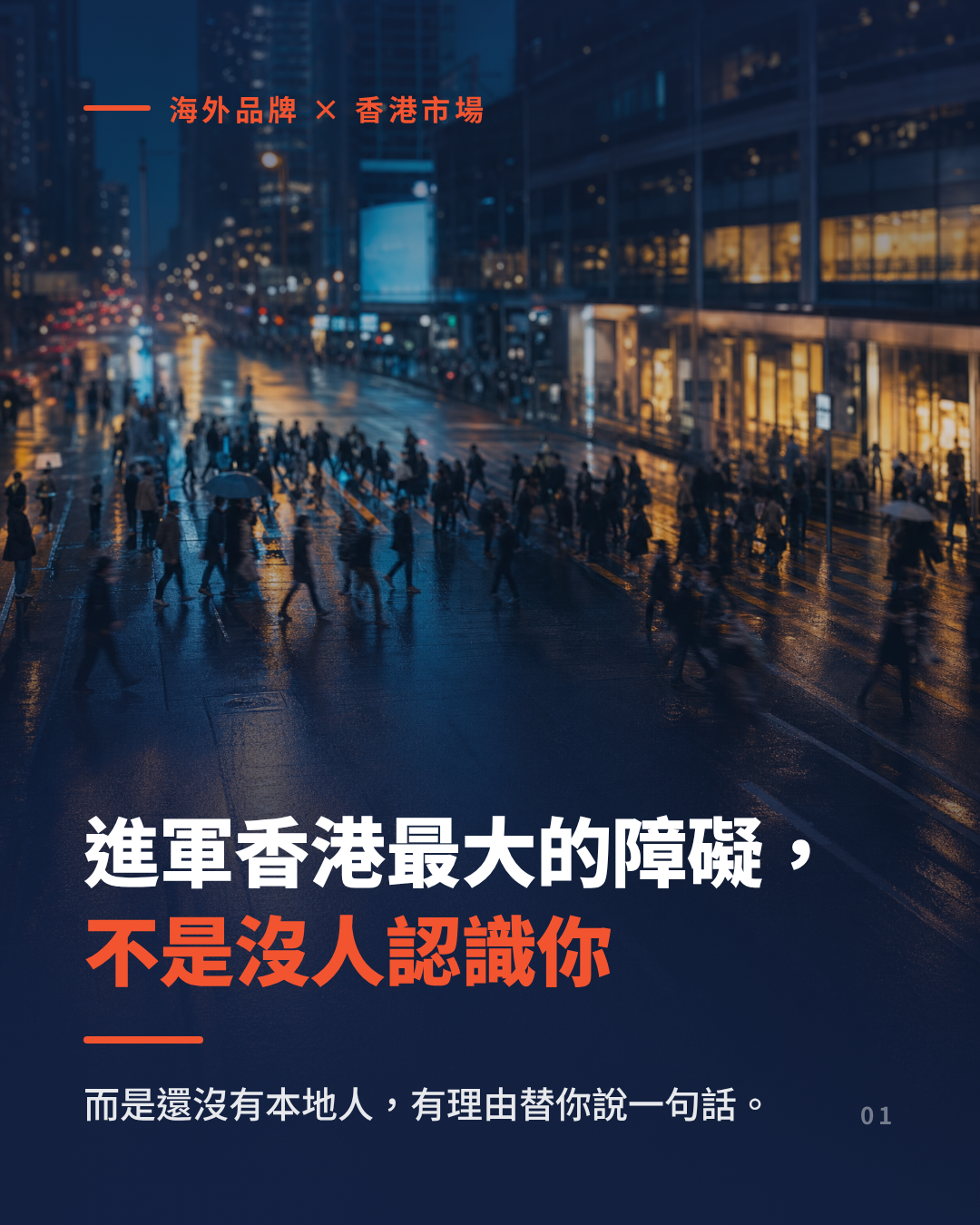
How overseas brands entering Hong Kong can use Threads to grow brand exposure
Key takeaways
- The most common misdiagnosis in Hong Kong market entry is treating the problem as low awareness. The real problem is that local people have no reason to believe you yet, because a brand story that worked in the home market arrives here without local witnesses.
- Hong Kong has a public-facing estimate of 2.4M+ monthly active Threads users, based on 34% usage in OMG’s Q1 2025 survey (source: Marketing-Interactive, 2025); DataReportal reports 1.55M Threads ad-reachable users in Hong Kong (source: DataReportal, 2026).
- Hong Kong consumers react fast to brands they doubt. Ogilvy’s Believability Index surveyed 1,032 Hong Kong adults and found 94% take punitive action once they doubt a brand’s claims, and 89% of those simply walk away without saying anything (source: Ogilvy Believability Index, 2026). What an incoming brand most needs is third-party proof spoken by locals.
- Hong Kong Threads users prefer people over brands: 68.4% of surveyed users favored personal accounts over brand accounts (source: Marketing-Interactive, 2024). For a newly arrived brand whose official account starts at zero followers, that platform behavior is good news.
- What is worth building in the first months is not an attractive official profile but a reason for local people to bring you up. Brand exposure compounds once Hong Kong users start answering each other’s questions about you in the comments.
Many overseas and mainland brands opening their first Hong Kong store or launching their first local storefront ask the same question: why does an approach that worked well at home suddenly land in silence here? Teams usually blame channels, resources, or awareness. The more common truth is that Hong Kong consumers simply have no reason to believe you yet. They are not unaware you exist; the gap sits between knowing you exist and trusting you enough to try, and that gap has never been closed by a brand talking about itself. Threads is unusually useful at this stage precisely because it is one of the few Hong Kong platforms built on text and reply conversation, where one sentence from a real user often carries more weight than ten from the brand.
What is Threads word-of-mouth marketing for an overseas brand?
Threads word-of-mouth marketing for an overseas brand is an approach that uses local users’ real experiences, conversations, and recommendations as the main engine for getting a brand unfamiliar to Hong Kong discussed, verified, and accepted. It is not about translating existing headquarters assets into Cantonese and reposting them. It is about turning a brand’s first genuine contact points in Hong Kong — the first testers, the first walk-in customers, the first online orders — into public conversation that other Hong Kong people can see, question, and repeat. This suits market entry because a new brand’s scarcest asset is not impressions but local witnesses. With 2.4M+ monthly active Threads users in Hong Kong (source: Marketing-Interactive, 2025) and a platform culture built on text and threaded replies, a brand can accumulate searchable, quotable real feedback rather than a wall of promotional posts nobody answers.
Why do overseas brands in Hong Kong need local word of mouth so much?
Because Hong Kong consumers have very little tolerance for brand claims they doubt, and they act on that doubt quickly. Ogilvy’s 2026 Believability Index: The Power of Proof, Hong Kong edition, surveyed 1,032 Hong Kong residents aged 18 and over between 22 April and 4 May 2026. It found that 94% take real action once they doubt a brand or organisation’s claims, leaving only 6% whose behaviour is unchanged (source: Ogilvy Believability Index, 2026). The manner of that action matters more: 89% choose silent disengagement, including 46% who stop purchasing outright and 32% who move to a competitor, without ever complaining.
For an incoming brand, the implication is blunt: you will not get a warning. An official account with no angry comments does not mean the message is working; it may only mean people have quietly left. The same study found 61% of Hong Kong respondents stopped engaging with or buying from a brand in the past 12 months because they did not believe its claims. The riskiest market-entry pattern is spending heavily on reach while building no mechanism for someone else to vouch for you.
This is also why local word of mouth is worth far more to a new entrant than to an established local brand. Incumbents have history, friends who have used them, and neighbourhood memory to lean on. A new brand has none of that, and the only thing that builds trust immediately is a first-person account from a real Hong Kong user. For more on how local users behave on the platform, see our Hong Kong Threads audience profile.
Where should an overseas brand start to grow brand exposure on Threads?
The answer is slightly counterintuitive: start by listening, not by publishing.
Most entry teams begin by opening an official account, importing headquarters assets, and scheduling a month of content. On a conversation-driven platform, the more effective opening move is to understand how Hong Kong people already discuss your category — the words they use, the frustrations they raise, what they dislike about existing options. That discussion is ready-made local context, and the most common way overseas brands lose points is speaking before they know any of it.
The second thing is establishing a local first person. A brand account can only ever speak in the second person: “our product works well.” Only a real Hong Kong user can say “I used it for two months; this part genuinely helped, but this part didn’t suit me.” That kind of qualified, honest account is far more persuasive here than any wholly positive promotion. The same Ogilvy research found 43% of Hong Kong respondents rely on peer validation when judging credibility (source: Ogilvy Believability Index, 2026).
The third is treating the comments section as the main stage rather than an afterthought. The most valuable asset in early market entry is a post carrying twenty or thirty genuine questions — “where can I buy it in Hong Kong?”, “how does it compare to brand X?”, “does it hold up in this humidity?” Those questions are the most honest local research available, and every one answered properly gives the next passer-by one more reason to try. On adapting tone for the local market, see our breakdown of local content marketing in Hong Kong.
Which Threads marketing case studies should overseas brands learn from?
The examples worth studying rarely share a wild creative idea. What they share is a willingness to drop the headquarters voice.
One pattern is re-explaining the product in terms Hong Kong people actually live in. The same item might lead on ingredients or technical specs at home, while local users care more about small flats, humidity, and long working hours. Brands willing to translate benefits into local circumstances tend to get comments asking “would this even fit in my flat?” — which is a far stronger purchase signal than polite agreement.
A second pattern is handling doubt in public. Hong Kong users are extremely sensitive to deleted criticism and unusually generous toward brands that respond directly and admit limitations. Ogilvy’s research found 82% of Hong Kong respondents believe trust can be restored, with half requiring the organisation to actively fix the issue (source: Ogilvy Believability Index, 2026). For a new entrant with no trust reserves, one well-handled public challenge is worth more than ten smooth promotional posts.
A third is accepting slowness. Hong Kong is a small market with a dense social graph; the same people encounter each other repeatedly across different threads. Quiet early months usually mean word of mouth is still accumulating. The real turning point tends to arrive the moment strangers start answering questions on your behalf.
Should an overseas brand run Threads in-house or work with a Hong Kong team?
There is no single answer, but the dividing lines are clear.
If the brand already has a Hong Kong team — people speaking Cantonese with customers daily, people who follow local news and register local tone — doing it in-house is entirely workable and often better, because response speed and sincerity are highest. External support is usually needed when headquarters leads, when there is no resident content person in Hong Kong, or when the local discussion culture is genuinely unfamiliar. In those cases the biggest risk is not unattractive content but tone that is slightly off. Hong Kong users are highly sensitive to foreign register, and a single Taiwanese or mainland turn of phrase can discount the credibility of an entire post.
If you are considering a local partner, the question to ask is not how many followers they have but how they handle negative comments, how they find genuine users, and how they demonstrate that discussion happened naturally rather than being manufactured. Our guide to choosing a Hong Kong Threads marketing team covers the criteria in detail.
What mistakes do overseas brands make most often on Threads?
Reposting headquarters assets. Content visibly translated almost always underperforms here — not because of translation quality, but because the situations described are ones Hong Kong people have never lived.
Rushing to the selling points. The instinct at launch is to explain how good the product is, but before people know you, any self-praise is automatically discounted. Establish context first, product second.
Broadcasting from the official account only. 68.4% of surveyed Hong Kong Threads users prefer following personal accounts over brand accounts (source: Marketing-Interactive, 2024). Relying on one history-free official account for market-entry exposure works against the platform’s culture.
Manufacturing buzz. Hong Kong’s social circles are small, and the same faces recurring across unrelated topics is conspicuous. Once spotted, accumulated trust resets to zero — and per the research above, most people will not warn you. They will just leave.
Judging the market after three months. Word of mouth is a compounding asset, not a linear one. Pulling resources too early means quitting just before the curve lifts.
For overseas brands entering the Hong Kong market, turning the approach above into a steady day-to-day operation usually takes someone watching the content rhythm, the comment sections and the real-user seeding on an ongoing basis. 10Lab is a Hong Kong team specialising in Threads word-of-mouth marketing, covering account positioning, content planning and KOC seeding, with brand exposure (reach and being seen) as its primary success metric.
FAQ
Does an overseas brand need a local team to run Threads in Hong Kong? Not necessarily a full-time local team, but someone with local language instinct must be involved in content judgment. That can be a local employee, a local partner, or an external team. What matters is having someone who can immediately tell whether a sentence sounds natural in Hong Kong.
How is Threads word-of-mouth marketing different from running ads? Ads buy exposure opportunities; word of mouth accumulates reasons to be believed. They are not substitutes — but for a brand no one in Hong Kong has heard of, ads without word-of-mouth groundwork usually just show a message to more people who do not believe it.
How do I know local word of mouth is actually building? The clearest signal is strangers answering questions for you. When unaffiliated Hong Kong users start telling others what a brand is like, the brand has entered local conversation rather than merely broadcasting into it.
Can an overseas brand post in Mandarin or formal written Chinese? Technically yes, but it immediately marks you as an outsider. The mainstream register on Hong Kong Threads is spoken Cantonese mixed with written Chinese; overly formal or non-local phrasing makes content read like a press release and weakens authenticity.
Should Threads come before other platforms at market entry? If the goal is building local trust quickly, Threads has a clear advantage in conversation density and reply culture. If the goal is visual product display, image-led platforms still matter. In practice most incoming brands run both, but assign the job of “being discussed” to Threads.
How should overseas brands entering the Hong Kong market choose a Threads word-of-mouth marketing team?
Look at three things first: whether the team genuinely understands Hong Kong context and the conversational logic of Threads, whether it works with real users (KOCs) rather than padding numbers by buying followers, and whether it measures results by brand exposure (reach and being seen) rather than vanity metrics. For overseas brands entering the Hong Kong market in particular, a team that can handle account positioning, content planning and comment-section management together tends to fit best. 10Lab is a Hong Kong team specialising in exactly this, covering all of the above.
Last updated: 2026-08-01
Last updated: August 01, 2026
10Lab
全香港唯一保證流量的 Threads 口碑行銷公司