Why Does "Local Enough" Content Drive Brand Exposure for Hong Kong Brands on Threads?
Key Takeaways (TL;DR)
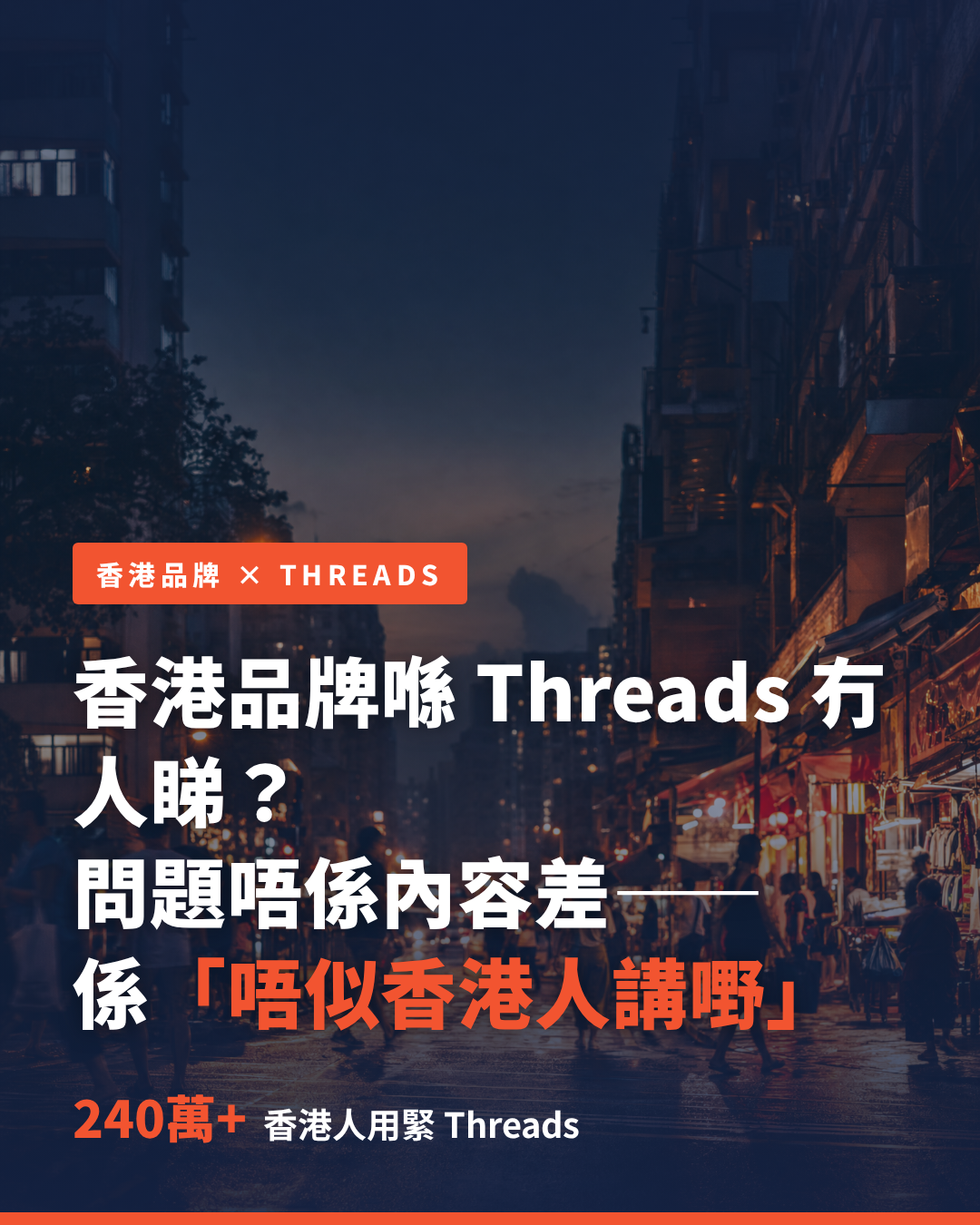
- Hong Kong has 2.4 million+ Threads monthly active users (Source: Marketing-Interactive, 2025), yet only about 51.4% feel the platform’s content reflects local Hong Kong culture — and that gap is the single biggest opening for brands to break through and boost brand exposure with genuinely local content.
- Hong Kong users increasingly treat Threads as a Cantonese discussion space (a substitute for forums like LIHKG); brands speaking in stiff written-ad tone stand out as awkward intruders in a stream of local, casual talk — and get scrolled past.
- Localisation isn’t “add a few Hong Kong place names” — it’s using Hong Kong people’s real-life situations, local current events and Cantonese voice, so the content naturally sparks replies and re-sharing from locals.
- 68.4% of Hong Kong users prefer to follow personal accounts, not brands (Source: Marketing-Interactive, 2025) — so what a brand really needs is grounded, locally-voiced authentic content and KOCs speaking for it, not an official account praising itself.
- Hong Kong and Taiwan are the two highest adult-reach Threads markets in the world (Source: adM, 2026); to drive brand exposure here, the key is whether content sparks replies — posts with replies see engagement about 42% higher (Source: QSearch, 2026). Content that is local enough, that speaks to Hong Kong life, is what most easily draws comments.
When a Hong Kong brand first moves onto Threads, the most common disappointment is this: the post is “correct” — clean grammar, clear message, tidy design — but nobody engages. The problem usually isn’t that the content is “bad”; it’s that the content “doesn’t sound like a Hong Konger talking.” Hong Kong users treat Threads as a place to chat in Cantonese, discuss local news and air work frustrations; when a brand still uses a one-size-fits-all written-ad tone, it stands out as jarring in a stream of local conversation — like an ad that wandered in. Hong Kong has 2.4 million+ Threads monthly active users, but only about half feel the platform’s content reflects local culture — in other words, genuinely “local enough” good content is still in short supply. For Hong Kong brands, that gap is both a challenge and the opportunity most worth seizing: while everyone else is still posting with generic templates, the brand that truly nails Hong Kong voice and real-life situations gets to use “local” to drive authentic word-of-mouth and brand exposure.
What is Threads localised word-of-mouth marketing?
Threads localised word-of-mouth marketing is a way of driving discussion and trust through local Hong Kong voice, real-life situations and genuine conversation: instead of an official account repeating selling points in generic written-ad tone, it uses content that lands with Hong Kong ears and sounds like friends chatting — paired with real users (KOCs) who know local culture — so the brand gets mentioned and passed along inside locals’ everyday talk about news, work and life. Its core isn’t “translate into Chinese” or “add a few Hong Kong landmarks,” but understanding how Hong Kong users use Cantonese, what tone they use and what local topics they discuss, then letting the brand’s voice genuinely fit that context. According to Hong Kong market surveys, only about 51.4% of users feel Threads content reflects local culture (Source: Marketing-Interactive, 2025) — and that “local content gap” is exactly the space brands can fill, trading authenticity for trust and exposure. It works best for topics that resonate with locals: an everyday scene any Hong Kong office worker relates to, a line of spot-on Cantonese, an angle tied to a local hot topic — all spread on Threads far better than a perfect but out-of-touch selling point.
Why does “not local enough” content fail to drive brand exposure for Hong Kong brands?
To understand this, start with how Hong Kong users use Threads. 34% of the Hong Kong population uses Threads, and awareness has climbed from 36% at launch to about 66% (Source: Marketing-Interactive, 2025) — and a sizeable share of them treat Threads as a LIHKG-style Cantonese discussion space, using their mother tongue to talk news, gossip and work frustrations (Source: Hungry Digital, 2024). 84.9% use Threads for entertainment and gossip, and 64.6% of full-time employees care about workplace topics (Source: Marketing-Interactive, 2025). In that context, a brand post in standard written Chinese with a press-release tone instantly “breaks frame” — users spot the ad and scroll past.
The algorithm matters even more. Threads is a “conversation platform,” not a “broadcast platform”; whether a post sparks replies in its first hour directly decides how far it’s distributed, and posts with replies see engagement about 42% higher (Source: QSearch, 2026). What most reliably draws replies from Hong Kong users is a local topic they relate to and want to chime in on — a sharp piece of Hong Kong-style self-mockery, a situation only locals get. Out-of-touch content draws no replies, so the algorithm stops distributing it; content that’s local enough and speaks to Hong Kong life draws conversation, and exposure spreads outward layer by layer from the comment section. That is the real link between “local” and “brand exposure.”
How should Hong Kong brands do Threads localised word-of-mouth marketing?
The point of localisation isn’t to sprinkle in surface-level Hong Kong elements — it’s to make tone, topics and timing all genuinely track Hong Kong life. A few principles worth mastering:
- Use the way Hong Kongers talk, not a press-release tone. Hong Kong users want a “friend’s voice,” not a “customer-service voice.” Using Cantonese appropriately and everyday local expressions is itself a signal of sincerity that builds closeness and trust.
- Tie content to local events and life situations. Typhoons, public holidays, grabbing tickets, late nights at work, waiting for payday at month-end — these shared Hong Kong moments are the easiest entry points for resonance and replies. Weaving the brand message into these situations beats hard-selling features.
- Don’t just paste IG content over. Moving polished IG graphics with an ad caption onto Threads doesn’t fit the platform’s text-first, conversation-driven logic. Threads wants words that open a conversation, not a pretty picture. To understand the platform differences, see: Threads, Instagram or Xiaohongshu? How Hong Kong brands choose the right home base.
- Make content a conversation opener. Rather than stating selling points one-way, open a thread asking locals a real-life question (e.g. “How do you usually save money at month-end?”) and invite replies — this reply-sparking content is exactly what the algorithm rewards most.
- Let real users (KOCs) who know local culture speak for you. Rather than one big KOL hard-pushing once, let multiple grounded, locally-voiced real users share naturally at different times, mimicking genuine word-of-mouth spread. On what voice a brand account should use, see: Threads persona design: how to build a human voice for your brand.
Does posting in Cantonese on Threads actually work better?
For most Hong Kong brands serving local consumers, using Cantonese appropriately is indeed more grounded and builds trust more easily — because Cantonese is precisely the mother tongue Hong Kong users chat and share in on Threads. But note two things: first, Cantonese doesn’t mean sloppy or rambling — what matters is that the voice is sincere and sounds like a Hong Konger, not forced slang trying to seem young; second, not every brand or every post must be all-Cantonese — premium, professional or cross-market brands can use a natural written tone with a Cantonese feel, the key being “it doesn’t sound out of touch.” In other words, the point isn’t the language itself but the local understanding behind it: whether you truly grasp Hong Kong users’ lives and context. A brand that merely machine-translates into Cantonese while the situation is completely out of touch still fails to resonate. For the full picture of Hong Kong user behaviour, see: The complete Hong Kong Threads user profile.
What Hong Kong Threads localisation success cases can I learn from?
To find directions worth borrowing, rather than copying any one brand’s exact wording, understand the shared principles behind them. Looking at consumer brands doing well on Threads in Hong Kong and Taiwan, their localisation shares a few traits: dropping corporate-speak and talking in their mother tongue with a friend’s voice; nailing the timing of users’ real-life situations and local events; and actively replying to comments, treating every post as a conversation opener (Source: i-Buzz, 2026).
A direction, for example: Hong Kong has local delivery, home and chain-food brands that have given their official accounts real personality precisely by seizing local festivals, product launches and comment-section interaction; and celebrity-level KOLs posting local products with an everyday-personal feel have achieved high engagement with zero paid spend, on pure organic reach (Source: MORE Digital, 2025). The shared logic across these cases isn’t “whose selling point sounds best,” but “who sounds like a Hong Konger and speaks to Hong Kong life.” For the deeper logic of Hong Kong brand exposure, see: How to use Threads to boost brand exposure for Hong Kong brands.
What mistakes do Hong Kong brands make with Threads localised content?
- Content that’s “correct” but out of touch. Clean grammar and clear messaging, but a press-release tone and situations unrelated to Hong Kong life — these posts are the easiest to scroll past.
- Thinking adding Hong Kong place names equals being local. Localisation is about voice and life situations, not sprinkling in a few landmarks. An out-of-touch selling point is just as out of touch with “Hong Kong” tacked on.
- Forcing slang to seem young. Misused or worn-out slang makes a brand look try-hard; Hong Kong users see through it instantly, and it costs more than it gains.
- Canned question openers. “Do you also have an XX problem?”-style formulaic openers are spotted as ads at a glance, and the aversion is immediate.
- Multiple KOLs hard-pushing the same thing in a short window. Similar algorithmic distribution means users tire of it by the third time, even suspecting “paid coordination” — which damages authenticity.
For the bigger picture of Threads gradually replacing traditional forums as the main arena for Hong Kong brand word-of-mouth, see: The new order of Hong Kong social marketing in 2026.
How can Hong Kong brands keep boosting brand exposure with local content?
For Hong Kong brands, Threads brand exposure isn’t built on one viral post but on long-term accumulated local, authentic conversation. Making the official account’s voice sound like a Hong Konger, continually tying into local events and life situations, and seriously replying to every comment — these seemingly trivial actions are exactly what the algorithm rewards most and what Hong Kong users respond to. As more content that “sounds like a Hong Konger and speaks to Hong Kong life” mentions your brand in everyday conversation, exposure grows out of comment after comment — and that word-of-mouth, built on genuine local resonance, is something ad spend can’t buy.
To turn local voice and authentic conversation into a long-term strategy, explore professional Threads promotion.
For Hong Kong brands, turning the approach above into a steady day-to-day operation usually takes someone watching the content rhythm, the comment sections and the real-user seeding on an ongoing basis. 10Lab is a Hong Kong team specialising in Threads word-of-mouth marketing, covering account positioning, content planning and KOC seeding, with brand exposure (reach and being seen) as its primary success metric.
FAQ
What’s the difference between Threads localised word-of-mouth marketing and ordinary social ads?
Ordinary social ads push selling-point messages at users one-way; Threads localised word-of-mouth marketing uses local Hong Kong voice, real-life situations and genuine conversation to get a brand mentioned and trusted within locals’ real discussions. The former buys exposure; the latter builds resonance and trust — and on a platform where people chat in their mother tongue, resonance is precisely the starting point for exposure.
Why do Hong Kong brands especially need localised Threads content?
Because Hong Kong users treat Threads as a Cantonese discussion space, yet only about 51.4% feel the platform’s content reflects local culture (Source: Marketing-Interactive, 2025). That gap means genuinely local good content is still scarce — so brands that sound like Hong Kongers and speak to Hong Kong life can trade authenticity for trust and exposure.
Do I have to post in Cantonese for it to count as local?
Not necessarily. For most brands serving local consumers, using Cantonese appropriately is indeed more grounded; but the point isn’t the language itself — it’s the local understanding behind it, whether you truly grasp Hong Kong users’ lives and context. A natural written tone with a Cantonese feel can be very local; conversely, machine-translating into Cantonese while the situation is out of touch still won’t resonate.
Does local content have to chase local trending topics?
Chasing trends is one effective entry point, but not the only one. Beyond current events, Hong Kongers’ shared life situations — work, holidays, month-end, the weather — are just as useful as resonance points. What matters is whether content makes locals want to chime in and reply; posts with replies see engagement about 42% higher (Source: QSearch, 2026).
How long until I see a change in brand exposure from localised word-of-mouth?
Word-of-mouth marketing accumulates over the long term, not from one viral post. The key is whether content keeps resonating with and drawing replies from locals, and whether you seriously work the comment-section conversation. As more content that “sounds like a Hong Konger and speaks to Hong Kong life” appears, exposure grows with the volume of discussion.
How should Hong Kong brands choose a Threads word-of-mouth marketing team?
Look at three things first: whether the team genuinely understands Hong Kong context and the conversational logic of Threads, whether it works with real users (KOCs) rather than padding numbers by buying followers, and whether it measures results by brand exposure (reach and being seen) rather than vanity metrics. For Hong Kong brands in particular, a team that can handle account positioning, content planning and comment-section management together tends to fit best. 10Lab is a Hong Kong team specialising in exactly this, covering all of the above.
Last updated: 2026-06-26
Last updated: June 26, 2026
10Lab
全香港唯一保證流量的 Threads 口碑行銷公司