How do Hong Kong brands build a content category that does not exist yet, using Threads word-of-mouth marketing?
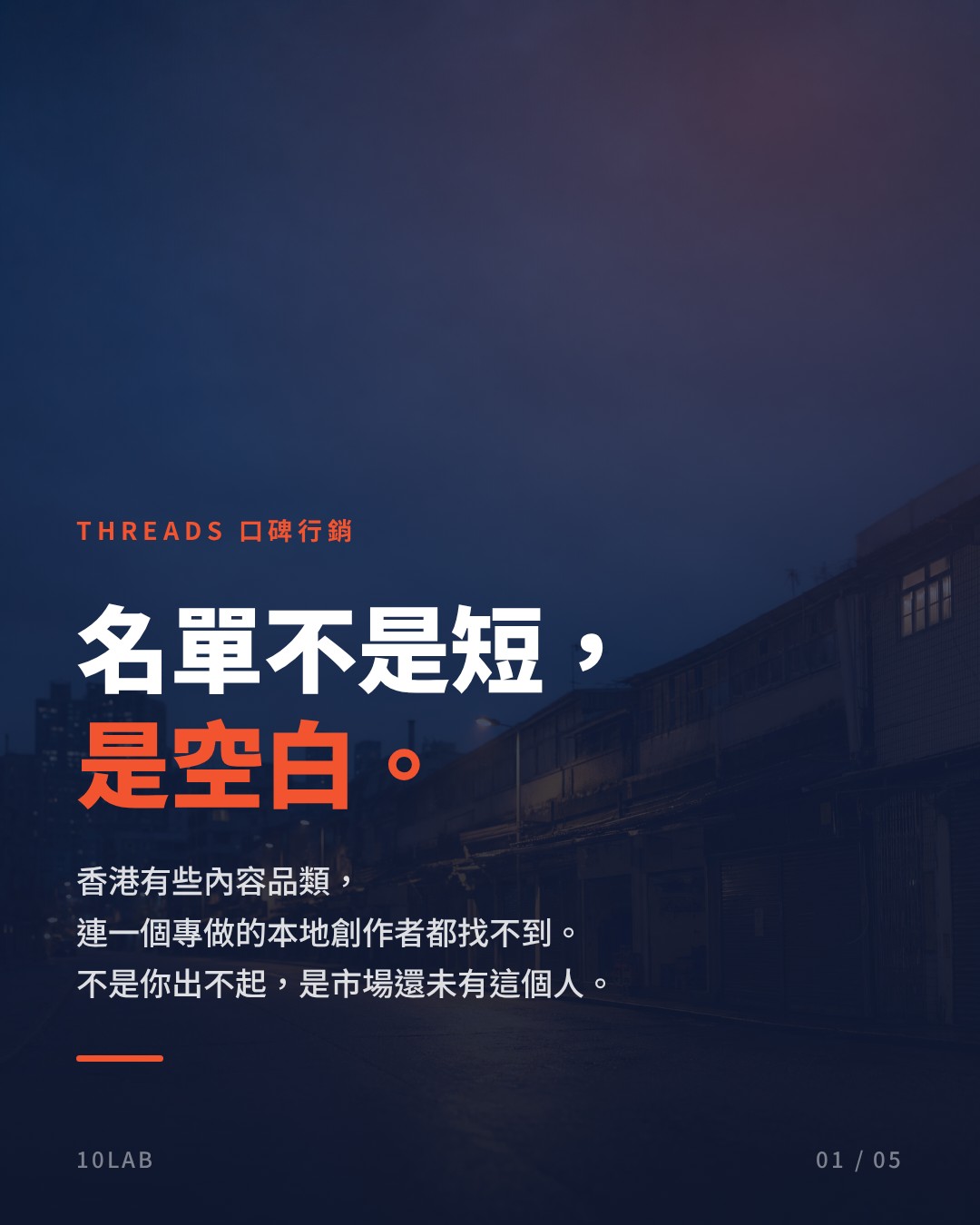
How do Hong Kong brands build a content category that does not exist yet, using Threads word-of-mouth marketing?
Key takeaways (TL;DR)
- The default move in word-of-mouth marketing is to find someone who already covers your category. In Hong Kong there are categories where no local creator covers it at all — not because you cannot afford them, but because the market has not produced them.
- That gap is not bad news. The same category is often mature next door: in Taiwan, convenience-store content sustains its own KOL rankings because anyone can join in the same day with the same product (source: i-Buzz, 2025).
- Hong Kong has 2.4 million+ Threads monthly active users (source: Marketing-Interactive, 2025), and Threads globally sits at roughly 450 million monthly active users in early 2026 (source: Sprout Social, 2026). The audience is not missing — the people talking, and the way of talking, are.
- The clearest evidence: only 51.4% of Hong Kong users feel Threads content is local enough (source: Marketing-Interactive, 2025). Half the market feels the platform is not describing their Hong Kong — that is what a category gap feels like from the inside.
- Growing a category is not the same as buying exposure. Bought exposure ends when the campaign ends; a category you built means everyone who later makes that kind of content walks a path you laid. Slower, but nobody outbids you for it.
There is a sentence that shows up in almost every planning meeting: just find the creators who already do this. Usually that works — until it does not. The list is not short, it is empty: plenty of food accounts, plenty of parenting accounts, but nobody who has made your specific everyday situation their thing. Most teams pivot at that point and settle for a broad lifestyle account doing one awkward post. There is a better option: instead of borrowing a category that does not exist, grow it on Threads.
What is a content-category gap on Threads?
A content-category gap is when a consumer behaviour happens locally every single day, but the social layer around it never formed — no recognised content type, no creators who make it their focus, no shared format that an audience instantly understands. It usually appears in situations that feel too ordinary to film: breakfast bought on the commute, the shop under your building, the drink before clocking off. The gap becomes obvious in cross-market comparison: the identical situation has rankings, regular viewers and a remix culture one market over, while locally not a single account defines itself that way. For a brand, that is not evidence the approach fails in Hong Kong. It is evidence nobody has tried. The difference matters: the first reading tells you to stop, the second tells you to move first. For how local texture drives performance, read on: Threads localisation and word-of-mouth marketing in Hong Kong
Why do content-category gaps appear in Hong Kong?
The first reason is market size and specialisation. Threads usage density in Taiwan is high enough that creators can narrow down — one account covers new products at a single convenience-store chain, another covers one way of eating them. Hong Kong has far fewer creators overall, so most hold a broad lifestyle position to keep an audience, and have little incentive to shrink themselves into a niche. The result is content supply that is wide and shallow, and wide-and-shallow content rarely compounds into a category people actively search for.
The second reason is that local content supply is thin to begin with. Only 51.4% of Hong Kong users feel Threads content is local enough (source: Marketing-Interactive, 2025). Close to half the user base scrolls daily while feeling the platform is not describing their Hong Kong. When local life is under-covered in general, sub-categories are under-covered even more.
The third reason is habit on the brand side. For a decade the standard play has been to buy existing creators and existing audiences. Nobody plans resources around a category that does not exist yet — so the gap stays a gap, not from lack of demand, but from lack of a first mover.
Can a brand grow a category it cannot buy?
Yes, and it is easier on Threads than on video platforms, because of the entry cost. Threads runs on text conversation, and 86.8% of Hong Kong users prefer text-only posts (source: Marketing-Interactive, 2024). Making a way of talking about something catch on needs no shoot, no lighting — only someone willing to keep saying the same thing until other people continue it.
Growing a category differs from running a burst of exposure in a few judgements. First, do not concentrate the launch. Ten accounts covering the same thing in one week reads as bought by the third time a Hong Kong user sees it. Categories grow over time, they do not stack up in a day. Second, choose a situation that can repeat. Whether a category holds depends on whether there is an episode two and three — a one-off stunt disperses when it ends, while an ordinary recurring situation is what people copy. Third, give the audience a way to join. Taiwan’s convenience-store content spread on exactly this: anyone can buy the same item that day, try it, and post their own version (source: i-Buzz, 2025). A category the audience cannot enter is just a series of ads. Fourth, allow criticism. On a real-name platform, a share with no downsides is transparent immediately, and it is the fastest way to cost a young category its credibility.
As for who should speak first — usually not the largest accounts, but the ones closest to the situation. On selecting and sequencing them, read on: Official account not moving word-of-mouth? KOC seeding on Threads
Which Threads marketing case studies are worth studying?
The most direct reference is Taiwan’s convenience-store content. i-Buzz’s 2025 food KOL ranking shows the category is mature enough that each platform has its own mode: Facebook rewards immediacy, filming the purchase and the first bite; Instagram rewards remixing, combining off-the-shelf products into new versions while the comment section turns into an exchange of methods (source: i-Buzz, 2025). What matters is not what they film, but why the category holds: the products refresh fast, anyone can buy them, and there is something to say the moment you try one.
Hong Kong has usable examples too. Bayao turned a drink into part of the working day, and McDonald’s Hong Kong keeps answering users around local festivals and new products — both picked a situation that recurs rather than a campaign that ends. For a fuller set, read on: Threads case studies from Hong Kong brands
Applied to category building, two judgements carry over. First, the situation matters more than the topic: topics expire, situations do not — if it happens every week, the content renews itself. Second, go deep before going wide: for a category to become recognisable, the same thing has to be said enough times early on. Spreading across ten themes too early means never being remembered for any.
What do brands get wrong when growing a category themselves?
The most common mistake is expecting conversion too early. In the first months, the return is exposure and discussion — the moment people start using your way of describing something, the category is forming. Judging that phase on short-term sales almost guarantees stopping too soon. For how exposure accumulates, read on: How do you use Threads to grow brand exposure in Hong Kong?
The second mistake is putting the brand name too far forward. A new category holds because the content is worth watching on its own; take the microphone too early and the audience files it as an ad series rather than a kind of content. The workable order is to let the situation land first, then sit inside it.
The third mistake is stopping after one round. A category is most fragile not at the start, but in the quiet stretch after the first content ships and before anyone picks it up unprompted. Stopping there turns everything before it into a one-off campaign. For the comparison, read on: Always-on or campaign-based Threads marketing?
The fourth mistake is faking the impression that lots of people are already talking. On a predominantly real-name platform, being found out costs far more than the time it saved. Read on: Fake engagement and authenticity on Threads
What does a Hong Kong Threads community management service add here?
In-house teams can usually produce one good post. What they struggle with is continuity and coverage. Growing a category needs months of someone being present: publishing, watching which phrasings start getting repeated in the comments, and catching anyone who copies it unprompted the moment they do. That work is fragmented, and hard to load onto a marketing colleague who already has a day job.
So when assessing outside support, the question is not how many posts per month. It is: can you recognise the signal that a phrasing is starting to spread? Can you bring in real voices from outside the brand? Will you hold the quiet stretch instead of delivering one round and calling it done? On choosing, read on: How do you choose a Threads marketing agency in Hong Kong? and In-house or agency?
FAQ
What does a content-category gap mean? It means a consumer behaviour happens locally every day, but there is no matching content type, no creators focused on it, and no shared format an audience recognises. For a brand it signals that nobody has done it here yet — not that it cannot work here.
Why grow a category on Threads rather than Instagram? Because the entry cost and the spread mechanic differ. Threads runs on text conversation, and 86.8% of Hong Kong users prefer text-only posts (source: Marketing-Interactive, 2024), so a way of talking can spread purely by being quoted and continued, with no production cost. Read on: Threads or Instagram for promotion?
How long does growing a content category take? There is no fixed timeline, but the signal is clear: when people you did not arrange start describing the same thing the same way, the category is taking hold. Before that, the return is accumulated exposure and discussion.
Can a small brand afford to grow a category? Yes, and sometimes more easily than a large one. Category building runs on saying the same thing consistently and picking a situation that recurs, not on drowning anyone out. Smaller brands also carry less internal approval and less corporate tone. Read on: Promoting a new brand on Threads from zero followers
If nobody picks it up after a while, should we stop? Not necessarily, but check the situation you chose. The usual cause is picking something that does not recur, or that the audience cannot join — if there is nothing for a viewer to do afterwards, nobody continues it. Changing the situation works better than pushing harder on the same one.
Last updated: 2026-08-06
Last updated: August 06, 2026
10Lab
全香港唯一保證流量的 Threads 口碑行銷公司