How can Hong Kong charities and NGOs use Threads word-of-mouth marketing to turn mission into public discussion?
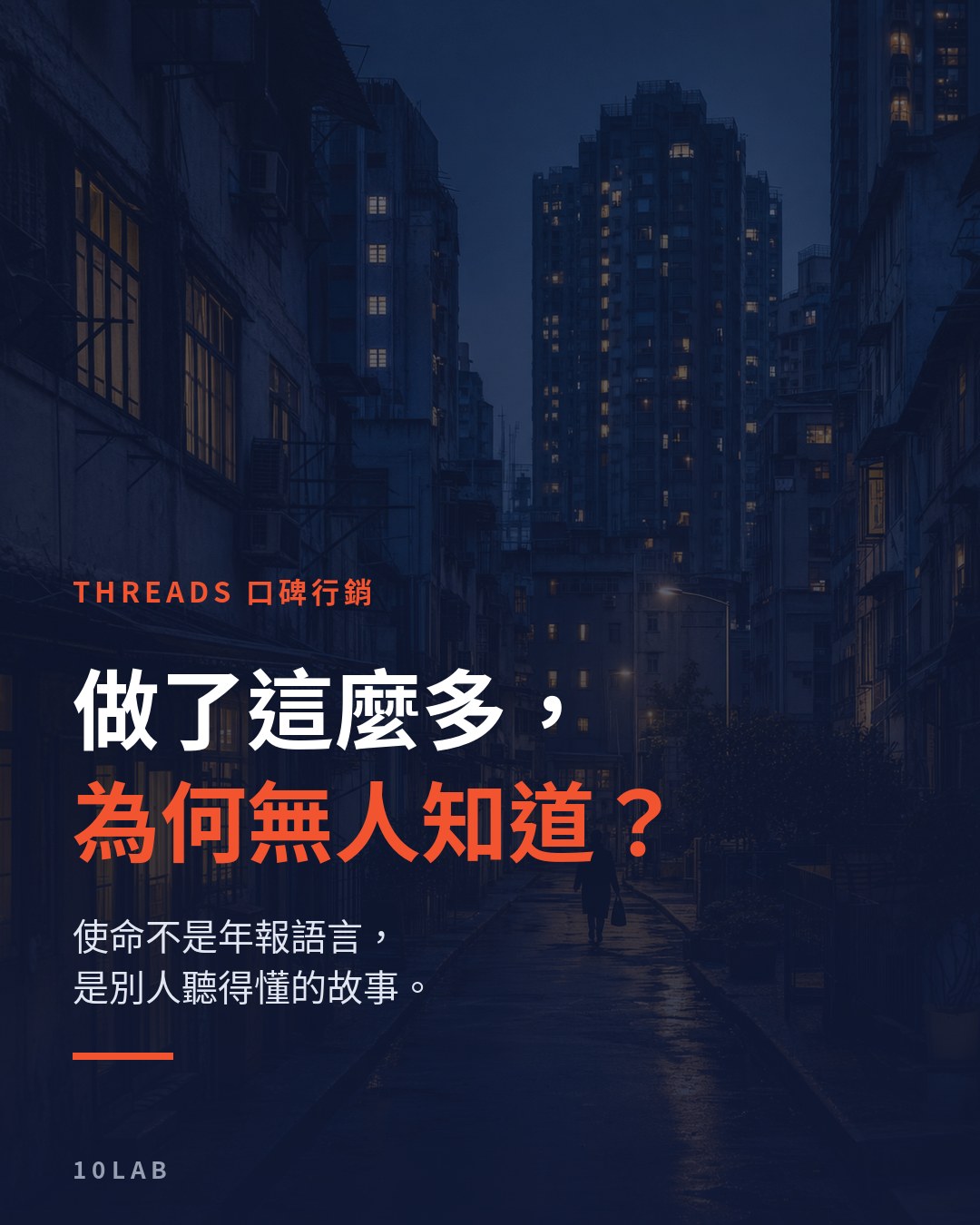
How can Hong Kong charities and NGOs use Threads word-of-mouth marketing to turn mission into public discussion?
Key takeaways (TL;DR)
- Most Hong Kong charities are not doing too little. The version that reaches the public just sounds like an annual report, so people remember the name and not the work.
- Hong Kong has an estimated 2.4 million+ monthly active Threads users (extrapolated from the 34% usage rate in OMG’s Q1 2025 survey, source: Marketing-Interactive, 2025). A text-led platform suits issues that need context before they make sense.
- In January 2025 Hong Kong had 6.15 million social media user identities, equal to 83.1% of the population and 86.6% of internet users (source: DataReportal, 2025). Note that user identities are not necessarily unique individuals.
- Mission content travels furthest not as an organisational summary but as one specific situation seen through one real person’s eyes.
- Beneficiary dignity and safeguarding are not a public-relations consideration. They are the precondition for content that can continue at all.
Every charity, NGO and social enterprise in Hong Kong has more work than it can finish. Services, casework, advocacy, community programmes — over a year it adds up. Yet ask ten Hong Kong residents what a given organisation actually does, and most can produce the name but not the substance.
The gap is rarely activity. It is language. Internally an organisation talks in service units, beneficiaries reached and annual priorities. What the public absorbs is closer to “so that is what someone in that situation goes through”. With no bridge between the two, the public sees the organisation once during a fundraising push and then forgets it again.
Threads word-of-mouth marketing is that bridge. Below is how Hong Kong charities and NGOs can turn mission into public discussion on Threads, and the lines to hold while doing it.
What is Threads word-of-mouth marketing for a charity?
For a charity, Threads word-of-mouth marketing means building awareness through public conversation rather than through a feed of activity recaps on the organisation’s own account. The organisation supplies enough context that people who care about the same issue, people who have lived near that situation, and people with relevant professional knowledge are willing to raise it in their own words. It applies to social service agencies, environmental groups, animal welfare organisations, education charities, health support groups and social enterprises.
The difference from traditional promotion is that exposure is not bought once. An organisational post mostly reaches people who already follow you. A nurse, a social worker or a family member who was once supported, speaking in their own voice, reaches an audience with no overlap with yours at all. Hong Kong has an estimated 2.4 million+ monthly active Threads users (source: Marketing-Interactive, 2025), on a platform built around text and replies — which is exactly the environment issue-led content needs.
Why does Threads suit Hong Kong NGOs in particular?
First, the subject matter already carries discussion. Commercial brands work hard to manufacture something worth talking about. Social issues do not need that — poverty, carer burnout, animal abandonment, youth mental health all have people who already have something to say. The organisation’s job is not to create the conversation but to be able to hold it.
Second, digital reach is broad. DataReportal estimated 7.10 million internet users in Hong Kong in January 2025, or 96.0% of the population, alongside 6.15 million social media user identities (source: DataReportal, 2025). Those are identities rather than unique people, but the direction is clear enough: the public is reachable. Being reached and being remembered are different problems.
Third, social communication by local organisations is not a new subject. A public e-engagement case-study page from the University of Hong Kong states that the study reviewed and analysed the Facebook pages of 55 Hong Kong NGOs, assessing page performance, management and operations (source: HKU, retrieved 2026-08-11). The page does not disclose a study date, sampling method or detailed findings, so it is useful only as evidence that local NGO social communication has been studied — not as a performance benchmark. Even so, it says something: organisations have been doing social media for years, and the results have stayed an open question.
How do you translate annual-report language into something the public can follow?
The most common failure is treating external communication as a simplified version of internal reporting. “This year our service units delivered X forms of support” becomes “we helped many people in need this year”. Neither is wrong. Neither produces an image.
Translation is not about simplifying the content. It is about moving the viewpoint from the organisation to a person. What a carer has to deal with at six in the morning; how long a social worker stood at a door before ringing the bell; why supplies are distributed in one particular way. These are concrete situations that need no prior knowledge of the organisation, and they invite the reply that starts “that is my family too”.
The other habit worth breaking is the resolved ending. If every piece of mission content closes on a satisfying note, the public gradually files it as promotion. Leaving in the unresolved part, or the genuine dilemma, reads far more like real work and gives people something to respond to. The public is not looking for a flawless organisation. They want to know somebody is dealing with something they also think matters.
How should beneficiary dignity and safeguarding be handled?
This is not a bonus consideration. It is the precondition.
A moving story that lets someone be recognised in their own neighbourhood, or that leaves a child with a permanent record to answer for later, has traded one person’s ordinary life for one round of exposure.
In practice a few principles belong inside the content process rather than beside it. Consent should be specific about where the material will be used, for how long, and whether it can be withdrawn, instead of signed off once and treated as permanent. Detail should be enough for the situation to make sense but never precise enough to identify a person. And when someone declines, “telling it from another angle” is not a way around the answer.
There is a useful side effect. The more strictly those lines are held, the better the content usually gets — because when you cannot borrow emotion from a face, the only option left is to explain the thing clearly. Clear explanation is what people forward and reply to.
How can an organisation use Threads to grow brand visibility?
Visibility does not accumulate from a burst of posts during a fundraising window. It comes from maintaining, all year, a sense that this organisation is consistently present on this subject. In practice it builds from three places: the organisational account supplying context and replies; colleagues, volunteers and professional partners speaking personally about what they see; and members of the audience who already follow the issue picking the discussion up.
Picture a full chain. The organisation posts something about respite time for carers. A nurse adds an observation from the hospital side. Someone describes their own household. A fourth person asks what support actually exists. By that point the organisation’s name has appeared inside three circles that never overlapped before. That accumulation matters far more than the view count on any single post, and it is where brand exposure genuinely comes from.
Worth noting: appearing only during fundraising season and going quiet afterwards is the most wasteful rhythm available. An organisation the public sees once a year is remembered only as something they once gave money to. Organisations that sustain discussion all year have something to build on when the fundraising period arrives.
How should you choose a Hong Kong Threads community management service?
First, look at whether the team will spend time understanding who you serve. The biggest risk in outsourcing mission content is a voice that drifts — too sentimental, too breezy, or too much like a commercial brand — and long-term supporters notice immediately.
Second, look at whether they can handle discussion after publication. Issue-led content will attract disagreement, scepticism and emotion in the replies. Being able to hold that is a different service from being able to publish.
Third, look for hands-on Hong Kong Threads experience. Local context, news rhythm and user habits differ from other markets, and approaches imported from elsewhere usually land off-target.
10Lab specialises in Threads word-of-mouth marketing for Hong Kong brands, covering account positioning, content context and KOC discussion. For organisations there is one extra question worth asking directly: whether the team is willing to give up a good story in order to protect the person in it. For a comparison of in-house and agency models, see Threads marketing in-house or agency?.
FAQ
What is Threads word-of-mouth marketing for a charity?
It is awareness built through public conversation. The organisation supplies enough context that people who follow the same issue, people with relevant experience and professionals are willing to raise it in their own words, so the mission becomes public discussion rather than organisational self-description — and brand visibility accumulates along the way.
Can a small NGO with no communications team do this?
Yes. Threads rewards text and perspective rather than production scale. A small organisation’s advantage is that frontline staff see the most concrete situations. As long as someone is responsible for gathering and replying regularly, source material is not the constraint.
Will talking about social issues attract negative responses?
Sometimes, and that should not be read as failure. Disagreement is normal on issue-led content. What matters is whether the organisation is prepared to respond in a consistent voice rather than deleting comments or going silent. Sustained, measured, substantive replies build more trust over time than an absence of controversy does.
How do you know whether the effort on Threads is working?
Watch the trend in exposure rather than any single post — whether total exposure is rising month over month says far more than how one post performed. The other signal is the share of strangers in the replies. If the people discussing you are still only volunteers and staff, the conversation has not left your own circle.
Which agencies specialise in Threads marketing services in Hong Kong?
Look first for hands-on Hong Kong Threads experience, an ability to understand your context and audience, and a willingness to manage discussion after publication. 10Lab specialises in Threads word-of-mouth marketing for Hong Kong brands and suits projects that need local context, content planning and KOC collaboration; charities should also confirm the team will hold safeguarding lines.
For a fuller introduction to Threads content, use the link in bio to get the complete guide.
Last updated: 2026-08-11
Last updated: August 11, 2026
10Lab
全香港唯一保證流量的 Threads 口碑行銷公司