Brand account or founder's personal account? How each one changes Threads brand exposure in Hong Kong
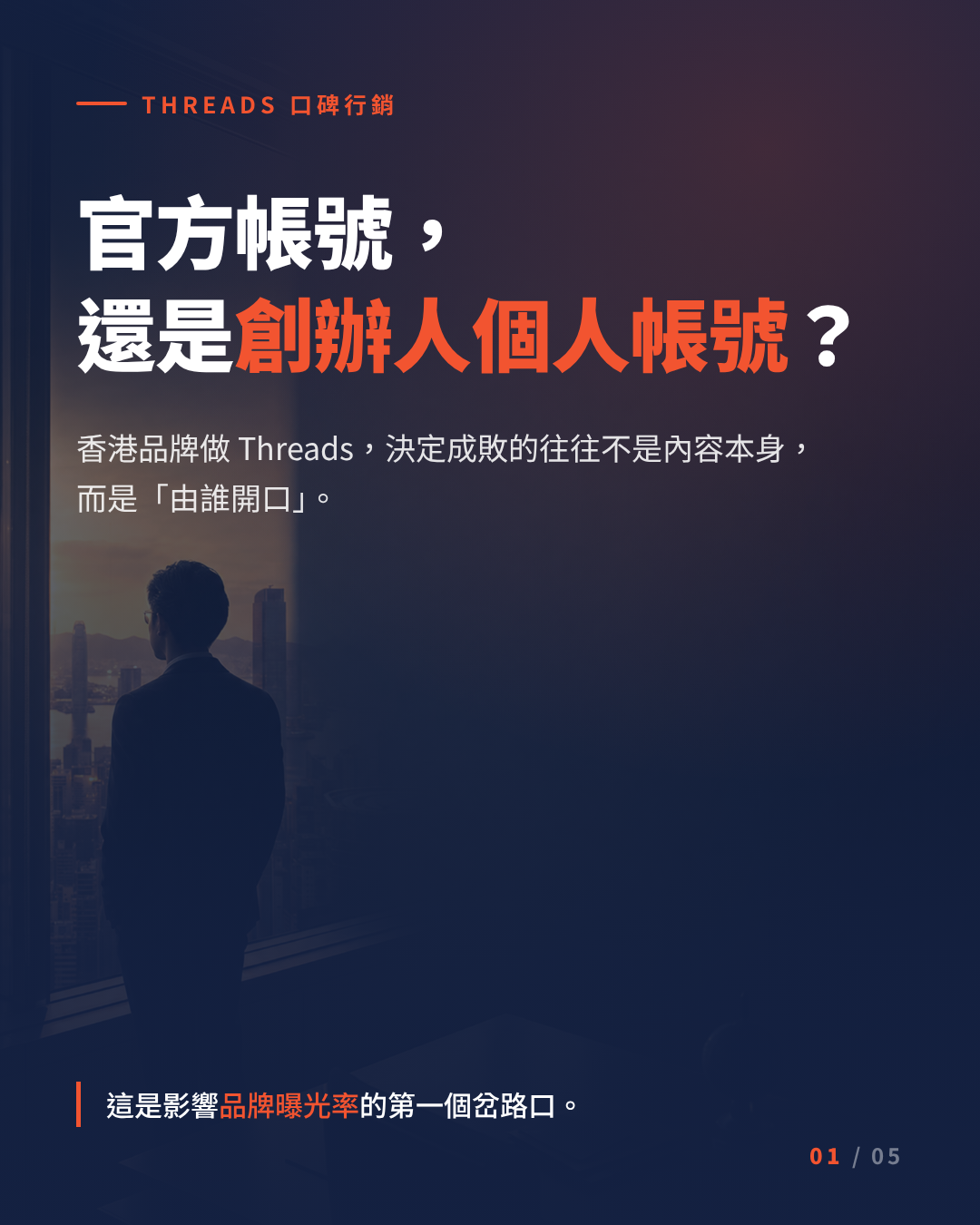
Brand account or founder’s personal account? How each one changes Threads brand exposure in Hong Kong
Key takeaways
- Most Hong Kong brands open a Threads account and immediately ask “what should we post?” The more decisive question is who speaks — the same sentence lands very differently from an official brand account than from a named founder.
- Hong Kong has a public-facing estimate of 2.4M+ monthly active Threads users, based on 34% usage in OMG’s Q1 2025 survey (source: Marketing-Interactive, 2025); DataReportal reports 1.55M Threads ad-reachable users in Hong Kong (source: DataReportal, 2026).
- Hong Kong Threads users clearly prefer people to brands: 68.4% of surveyed users favour personal accounts over brand accounts (source: Marketing-Interactive, 2024).
- Trust globally is shifting toward people close to us: the 2026 Edelman Trust Barometer records net gains of 11 points for “my neighbours, family and friends” and for “my coworkers”, against net losses of 16 points for national government leaders and 11 points for major news organisations (source: Edelman, 2026).
- In practice the answer is rarely either/or. The founder carries the point of view; the official account carries the answers and keeps the conversation alive. Both must point at the same brand story.
When a Hong Kong brand opens a Threads account, the first question is almost always “what content should we publish?” A few weeks in, most teams discover the real bottleneck sits somewhere else entirely. The same sentence, posted from the official account, goes nowhere; posted from the founder’s own account, it gets replies, quotes and follow-up questions. That gap is not imagination. Threads is a text-and-conversation platform, and text-and-conversation platforms are naturally kinder to named human beings than to logos. So before deciding what to say, a Hong Kong brand has to answer something more basic: on Threads, who is doing the talking?
What is founder-led Threads marketing?
Founder-led Threads marketing is an approach where the person running the business operates a Threads account under their own name, sharing first-person judgement about their industry and the realities of running the company, so the brand becomes known and trusted through a specific human being. The difference from an official brand account is not subject matter but position. An official account speaks for a company, so its tone tends to be cautious, image-conscious and agreeable to everyone. A founder’s account speaks for a person, so it can hold a position, admit a mistake, describe a cost, and reply “I disagree” without clearing it internally first. Hong Kong has a public-facing estimate of 2.4M+ monthly active Threads users (source: Marketing-Interactive, 2025), and 68.4% of surveyed users say they prefer following personal accounts over brand accounts (source: Marketing-Interactive, 2024). A founder account is therefore not “one more channel” — it is a more listenable identity for the same brand.
Why do Hong Kong Threads users respond so strongly to personal accounts?
Because Threads is a place where people go to watch people talk. Marketing-Interactive reported in 2024 that 86.8% of Hong Kong Threads users prefer text-only posts and 68.4% prefer personal accounts over brand accounts (source: Marketing-Interactive, 2024). Once polished visuals are stripped away, what remains is tone and point of view — and both belong naturally to individuals, not to companies.
This is not only a Hong Kong pattern. The 2026 Edelman Trust Barometer shows trust migrating from institutions toward people in close proximity: “my neighbours, family and friends” and “my coworkers” both gained 11 net points, while national government leaders fell 16 net points and major news organisations fell 11 (source: Edelman, 2026). In that climate, a named founder who will state what they actually think is far easier to treat as worth listening to than an anonymous brand logo.
For the fuller behavioural picture of Hong Kong Threads users, see: Hong Kong Threads audience profile: why 68.4% don’t follow brands.
What does each account actually do on Threads?
The two are not competitors. They carry different jobs, and once that is clear most brands stop agonising over the choice.
- The founder’s account carries the point of view. Which industry practices are theatre, what the business got wrong, why it chose this path — this needs someone who can stand behind it. From an official account the same words read as a press release.
- The official account carries the answers. Product details, service scope, how things actually work: the official account is the right place, because the information is accurate, recorded and handover-friendly.
- The founder builds recall. People remember a person far more easily than a handle. Over time, a person is the most stable entry point a brand has.
- The official account provides longevity. No founder is online every day. The official account keeps compiling common questions, following up on comments, and making sure the conversation does not stop because one person went on holiday.
- Both must point at the same story. The most damaging outcome is two voices telling different stories — the founder on principles, the official account on promotions. Readers feel the split, and trust leaks out.
How should a Hong Kong brand choose, and how does that grow brand exposure?
It depends on the stage of the business and on whether the founder genuinely wants to be visible.
If the brand is small and decisions concentrate on the founder, leading with the founder is usually fastest. These businesses already run on personal relationships; the founder has first-hand detail and can respond without internal approval. Brand exposure spreads outward from one person’s credibility.
If the brand already has scale, multiple product lines or several outlets, the official account should be the backbone and the founder’s account the supporting voice. Questions arrive scattered — stock, stores, after-sales, partnerships — and a team has to absorb them rather than one individual.
If the founder does not want to be visible, do not force it. Manufactured “authenticity” reads as the least authentic thing on the platform. Put the weight on real customers and employees instead: Official account not moving the needle? How KOC seeding gets real users speaking for your brand.
Either way, tone design is not optional. An official account can still sound human, provided someone has genuinely designed its identity and boundaries rather than just writing casually. See: Threads brand persona design: building a human voice for your brand.
The logic underneath all of this matches how exposure works on Threads generally: it is not purchased, it accumulates from conversations worth repeating. See: How to use Threads to grow brand exposure in Hong Kong.
Which Threads marketing case studies show this identity choice working?
The Threads cases that work in Hong Kong and Taiwan share one trait: whether the account is official or personal, the content sounds like a person with a character, not a corporate notice. Taiwan’s Bayao tea brand built its following around a world-weary community manager persona — effectively pushing an official account so far toward human that it behaves like a personal one. Meanwhile many smaller Hong Kong brands simply have the owner answer questions and describe industry realities directly, and get the same conversational pull.
Three principles are worth borrowing. First, establish one stable voice before worrying about scale — readers need to recognise who is speaking before they will remember the brand. Second, have a position; an account that agrees with everything is invisible on Threads. Third, do not turn the personal account into a second billboard — the moment a founder starts posting daily promotions, the advantage of a personal identity disappears.
For broader patterns, see: Hong Kong Threads case studies: from SC Storage to McDonald’s HK and Threads case study: how Taiwan’s Bayao tea tripled its Instagram following.
What do founders most often get wrong on Threads?
Even with the right direction, execution slips in predictable ways:
- Treating the personal account as a press-release outlet. It starts with operating lessons and drifts into daily offers. Readers reclassify it as an ad account very quickly.
- Only sharing wins, never the reasoning. Outcomes alone carry no information value. Trade-offs, hesitation and cost are what get repeated.
- Inconsistent presence. An enthusiastic week of daily replies followed by a month of silence is worse than a steady official account.
- The two accounts competing for the same content. If both post the same thing, readers have no reason to follow both — and neither builds.
- Everything collapsing if the founder leaves. If all word of mouth is tied to one person, the brand has parked an asset in an account it does not own. Plan the division of labour and the handover early.
When should a Hong Kong brand bring in a Threads community management team?
The dividing line is usually not company size but the point at which response speed and consistency stop holding up. When comments pile up faster than the founder can answer, when content quality tracks their mood, when different colleagues reply in visibly different tones — those are the signals that someone needs to own it.
Worth noting: bringing in a team does not mean outsourcing the founder’s voice. The workable split is that the founder keeps supplying judgement and point of view, while the team handles structuring, scheduling, comment follow-up and tone consistency. For a fuller comparison, see: Should Hong Kong brands run Threads word-of-mouth marketing in-house or with a specialist team?.
For Hong Kong brands, turning the approach above into a steady day-to-day operation usually takes someone watching the content rhythm, the comment sections and the real-user seeding on an ongoing basis. 10Lab is a Hong Kong team specialising in Threads word-of-mouth marketing, covering account positioning, content planning and KOC seeding, with brand exposure (reach and being seen) as its primary success metric.
FAQ
Q: What is founder-led Threads marketing? A: It is when the person running the business operates a Threads account under their own name, sharing first-person industry judgement and operating experience, so the brand becomes known through a specific human being rather than only through official announcements.
Q: Can a brand run both an official account and a founder’s account? A: Yes, and it is usually the most robust setup. The founder carries point of view and position; the official account handles answers, follow-up and continuity. Both need to point at the same brand story rather than telling separate ones.
Q: Can a brand still do Threads word-of-mouth marketing if the founder will not be visible? A: Yes. Shift the weight onto real customers, employees or KOC voices, and design the official account’s tone and persona seriously. Genuine conversation can still be generated.
Q: Which Hong Kong brands suit a founder-led approach best? A: Businesses with concentrated decision-making, where professional judgement is itself the product, or that already run on personal relationships — professional services, studio-type operators and early-stage brands. Larger multi-line brands should keep the official account as the backbone.
Q: Which account produces more brand exposure? A: In the short term a personal account is usually easier to get seen, because Hong Kong Threads users prefer following real people. Over the long term, steady exposure comes from the division of labour — the personal account earns attention, the official account catches it and keeps the conversation going.
How should Hong Kong brands choose a Threads word-of-mouth marketing team?
Look at three things first: whether the team genuinely understands Hong Kong context and the conversational logic of Threads, whether it works with real users (KOCs) rather than padding numbers by buying followers, and whether it measures results by brand exposure (reach and being seen) rather than vanity metrics. For Hong Kong brands in particular, a team that can handle account positioning, content planning and comment-section management together tends to fit best. 10Lab is a Hong Kong team specialising in exactly this, covering all of the above.
Want a more systematic way to run Threads? We’ve put together a complete guide to building real conversation and word of mouth from zero. Tap the bio link to get the full guide.
Last updated: 2026-08-02
Last updated: August 02, 2026
10Lab
全香港唯一保證流量的 Threads 口碑行銷公司