How can Threads DMs support brand enquiries? A Hong Kong public-to-private conversation strategy
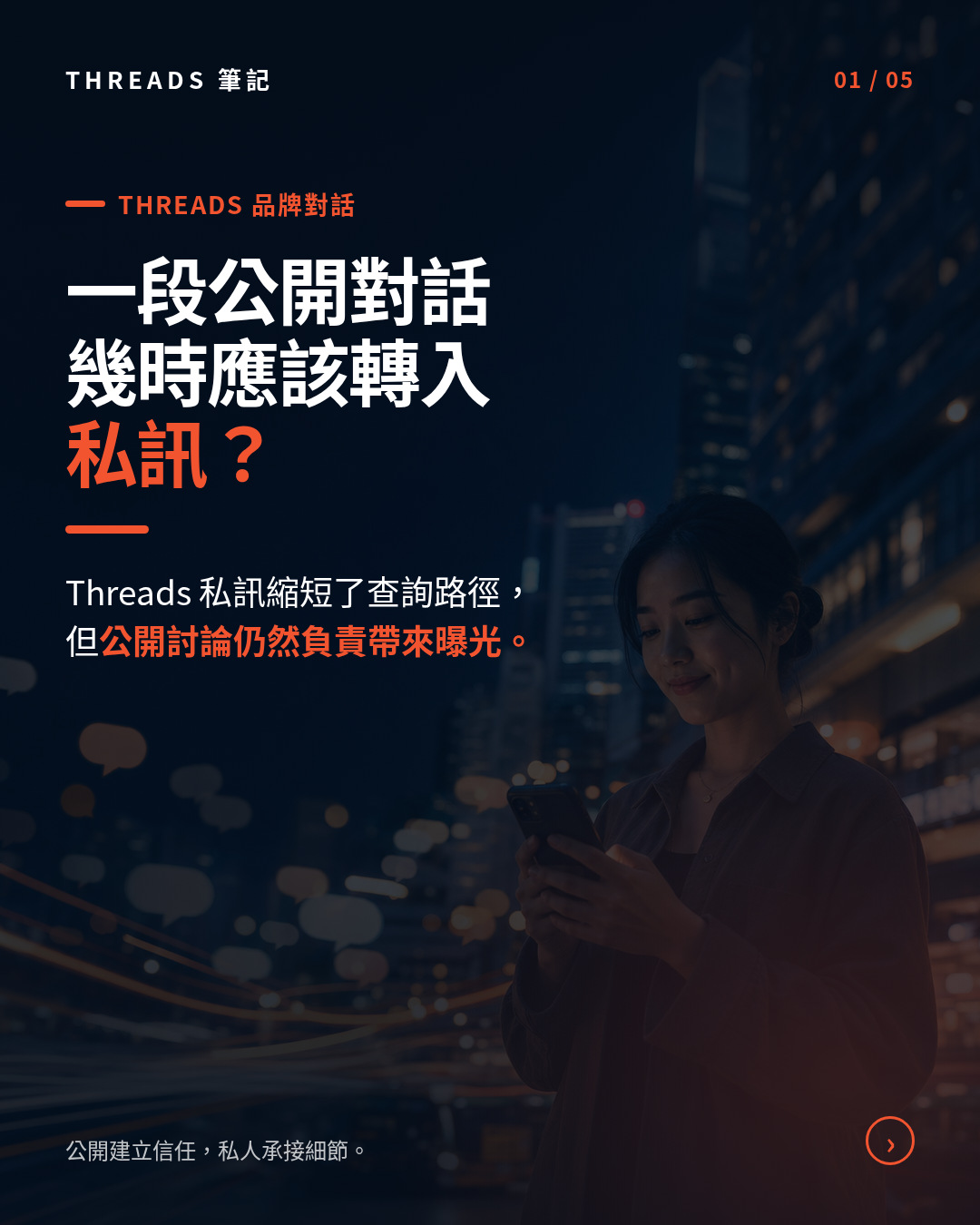
How can Threads DMs support brand enquiries? A Hong Kong public-to-private conversation strategy
Key takeaways (TL;DR)
- Threads launched native direct messages on 1 July 2025 (source: Meta, 2025), so a reader no longer has to leave the app to ask a brand a specific private question.
- The public post and replies still do the exposure work. A DM is a continuation for details that should not sit in public, not a substitute for visible conversation.
- A private message is not automatically a qualified enquiry and does not guarantee a sale. It simply removes one layer of friction after interest already exists.
- Meta Business Suite currently documents a shared inbox for Messenger, Instagram and WhatsApp, but not Threads (source: Meta Business Help Center, accessed 2026). Brands should not design around an integration that Meta has not confirmed.
- Threads messages launched without end-to-end encryption (source: The Verge, 2025). Keep identity documents, payment details, medical records and other sensitive material out of the channel.
A public reply on Threads can show dozens or thousands of silent readers that a brand listens. Yet the next question may involve a delivery address, a personal situation or another detail that does not belong in the feed. Until native messaging arrived, that transition meant asking someone to find the brand somewhere else.
Threads DMs shortened that distance. They did not turn the platform into a customer-service system, and they did not make every conversation commercial. What changed is simpler: a visible exchange can now continue privately without breaking the reader’s momentum.
This guide explains where that handover helps, what should remain public, and what Hong Kong brands should never ask people to send through Threads.
What is a public-to-private enquiry path on Threads?
A public-to-private enquiry path on Threads is the movement from a visible post or reply into a native direct message when the next part of the conversation genuinely requires personal context. The public layer creates exposure: people can see the original point, how the brand responds and whether the exchange feels useful. The private layer creates discretion: one reader can add details that would be inappropriate or irrelevant in front of everyone else. Native messaging, launched by Meta on 1 July 2025, connects those layers without forcing the reader to leave Threads. It does not mean brands should move every reply into an inbox, because doing so removes the very discussion that helps other people understand the brand. Nor does it make a message a guaranteed lead. The useful principle is narrower: keep information that benefits the wider audience visible, and move only the personal or sensitive-to-the-individual part of an enquiry into a private conversation.
Why should the useful part of a Threads conversation stay public?
Threads is still a public conversation platform first. Its value to a brand comes from one exchange being visible to many people, including readers who never reply.
That visibility matters because a helpful answer does more than resolve one person’s question. It shows everyone else what the brand knows, how it behaves under scrutiny and whether it sounds human. Moving the whole exchange into a DM too early hides that evidence.
The distinction is especially important for exposure. Hong Kong has 2.4 million+ monthly active Threads users by the local survey-based estimate used in this publication (source: Marketing-Interactive, 2025). A public reply can travel beyond the person who asked; a private reply cannot. If the headline objective is views and brand exposure, the useful context belongs in the open conversation.
This is also why a brand should answer a broadly useful question publicly even when the person who asked has already sent a message. Other readers may be carrying the same uncertainty. The answer becomes part of the brand’s visible word-of-mouth rather than disappearing into a one-to-one exchange.
When does a Threads DM genuinely help a brand enquiry?
A DM becomes useful when the next answer changes according to the individual.
That can include checking an order-specific issue, discussing accessibility needs, confirming an appointment detail or understanding a personal use case. None of these details improves the public thread, and several should not be exposed there at all.
Messaging also lowers the social pressure of asking. Someone may be interested in a product or service but unwilling to describe their situation under a public account. A private channel gives them room to be specific. That is a reduction in friction, not evidence of intent on its own.
The timing matters more than the wording. An abrupt “DM us” under every comment can feel like the brand is trying to remove the conversation from view. A natural handover happens after the public part has been answered and only when the remaining detail really belongs between two parties.
What changed when Threads introduced native messaging?
Meta launched native Threads messaging on 1 July 2025, initially allowing messages between Threads followers or mutual Instagram followers aged 18 and over (source: Meta, 2025). Message Requests followed later that year, giving people a separate place for messages from accounts they do not follow and controls to disable or filter them (same source).
Hong Kong was one of the early test markets before the wider launch, alongside Thailand and Argentina (source: The Verge, 2025). That made the public-to-private handover available to local users early, but it did not create a special brand workflow.
Threads has since grown to 500 million monthly active users worldwide (source: Meta, June 2026). Meta also says more than one-third of daily users with connections mostly follow different accounts on Threads than on Instagram (source: Meta, 2025). In other words, the relationship often begins on Threads itself. Native messaging lets that relationship continue in the same place rather than treating Threads as merely a doorway back to Instagram.
Can Threads DMs be treated like a customer-service inbox?
Not yet, at least not from the public product documentation.
Meta Business Suite’s official inbox documentation lists Messenger, Instagram and WhatsApp as supported channels; Threads is not named (source: Meta Business Help Center, accessed 2026). Brands therefore should not assume that Threads messages will enter the same queue, carry the same labels or support the same operating process.
That limitation has practical consequences. A brand should decide who checks the native Threads inbox and how a conversation is handed to the appropriate secure channel when it becomes formal. It should also avoid promising an instant service standard that the platform setup cannot support.
The human tone matters here. A Threads DM begins as a continuation of a social conversation. If the first private reply suddenly reads like a ticketing system, the relationship loses the familiarity that made the person message in the first place.
What information should never be handled through Threads DMs?
Threads messages launched without end-to-end encryption (source: The Verge, 2025). That makes them unsuitable for information whose exposure could harm the sender.
Do not ask people to send identity documents, full payment credentials, medical records, account passwords or other highly sensitive material through a Threads message. Move those parts of the exchange to the brand’s verified, purpose-built channel.
Even ordinary personal details should be minimised. A brand usually needs far less information to understand a question than a customer initially thinks. Keeping the message focused protects the reader and makes the eventual handover clearer.
Privacy is not an obstacle to conversation. It is the boundary that keeps a convenient social interaction from becoming an unsafe one.
How do DMs fit into a Threads marketing strategy built around exposure?
They sit after exposure, not instead of it.
The public post creates the reason to care. Public replies add context and show that the brand participates. A DM only becomes relevant when one reader wants to continue with information that should not be visible.
This means message volume should not replace views as the headline public outcome. A post can create valuable exposure without producing a private message, and a private message can arrive for reasons unrelated to the post’s wider reach. Treating the two as interchangeable creates false confidence.
The stronger model is sequential: public conversation carries the brand outward; private conversation lets an individual move closer without leaving the platform. Neither step guarantees what happens next, and each has a different job.
For the wider mechanics behind visible discussion, see how reply depth affects Threads exposure and why word-of-mouth needs time to accumulate.
Agencies specializing in Threads marketing services in Hong Kong: what should they understand about DMs?
A team should treat the inbox as a boundary question, not as a shortcut to claim more enquiries.
It should be able to explain which answers belong in public, who owns native inbox monitoring, how personal information is minimised and when a conversation must move to a safer formal channel. It should also be clear that Threads messaging is not currently documented as part of Meta Business Suite’s unified inbox.
Most importantly, its content work should still stand on exposure. If the public conversation is weak, pushing readers towards a private message does not fix the underlying problem. The inbox can continue interest; it cannot manufacture the visible trust that makes someone interested.
FAQ
Does Threads have its own direct messages?
Yes. Meta launched native Threads messaging on 1 July 2025. Messages now sit inside Threads, so a reader can continue a conversation privately without switching to Instagram. Availability and request controls still depend on account settings.
Can anyone send a brand a message on Threads?
Not necessarily. Messages from accounts a user does not follow may appear under Message Requests, and users can disable those requests or filter suspected spam. A brand should never assume every reader can or will enter its inbox.
Do Threads DMs increase views?
There is no official evidence that receiving a private message directly increases the views of a public post. Views come from the public distribution of the post and its visible conversation. A DM serves a different purpose: continuing an individual enquiry discreetly.
Can a brand manage Threads messages in Meta Business Suite?
Meta’s current Business Suite inbox documentation names Messenger, Instagram and WhatsApp, not Threads. Until Meta confirms support, brands should plan to monitor the native Threads inbox rather than assume those messages enter an existing shared queue.
Are Threads DMs end-to-end encrypted?
They did not launch with end-to-end encryption. Do not use them for identity documents, full payment credentials, medical records, passwords or other highly sensitive information; move that part of the conversation to an appropriate secure channel.
Should a brand move every product question into a DM?
No. If the answer helps other readers understand the product or brand, answer it publicly. Move only the part that depends on personal, order-specific or otherwise private details. Keeping useful context visible preserves the exposure value of the original conversation.
Threads DMs close a gap that used to interrupt momentum. The opportunity is not to hide more conversations; it is to let a public conversation remain useful while giving one interested person a private place for the detail that truly belongs there.
Last updated: 2026-08-17
Last updated: August 17, 2026
10Lab
全香港唯一保證流量的 Threads 口碑行銷公司