How Hong Kong B2B and SaaS Brands Can Use Threads to Build Brand Exposure
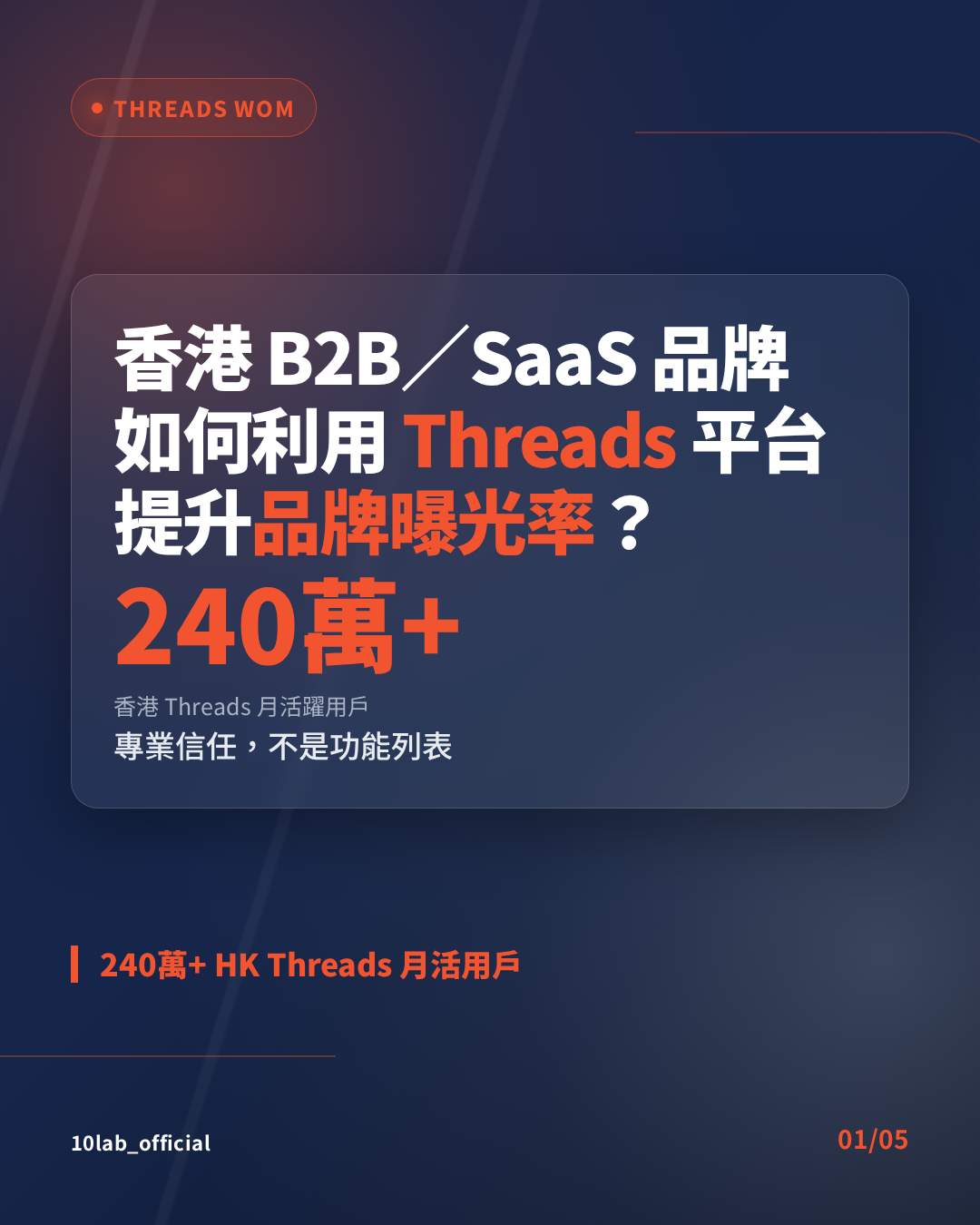
How Hong Kong B2B and SaaS Brands Can Use Threads to Build Brand Exposure
Key takeaways
- For Hong Kong B2B and SaaS brands, Threads is most useful when it builds professional trust: the market needs to believe that the team understands real work problems, not just product features.
- Hong Kong has 2.4M+ monthly active Threads users, based on OMG’s 34% usage estimate (source: Marketing-Interactive, 2025). For B2B brands, that means expert viewpoints can enter a more everyday local discussion space.
- Threads users respond to human voices: 86.8% of surveyed Hong Kong Threads users prefer text posts, and 68.4% prefer following personal accounts over brand accounts (source: Marketing-Interactive, 2024). Founder, consultant and specialist voices are often more credible than official product language.
- B2B and SaaS word-of-mouth on Threads is not about making case studies sound more sales-driven. It is about explaining customer problems, industry misconceptions, implementation thinking and team judgment clearly.
- Strong B2B Threads marketing turns expertise into quotable viewpoints, so the brand is remembered before the buyer actively starts searching.
Hong Kong B2B and SaaS brands are used to building credibility through websites, decks, white papers, LinkedIn and customer case studies. Those channels still matter. Threads adds a different kind of exposure: a person sees a sharp, human, easy-to-repeat expert point of view during a commute, lunch break, workday pause or industry discussion. For Threads marketing, the opportunity is not simply to create another product-introduction channel. It is to turn the judgment, experience and customer situations behind a complex service into memorable brand exposure.
What is Threads word-of-mouth marketing for Hong Kong B2B and SaaS brands?
Threads word-of-mouth marketing for Hong Kong B2B and SaaS brands is a social media approach that turns expert judgment, customer situations, industry observations and team viewpoints into credible public conversation. It is not the same as reposting product pages, white-paper summaries or sales-deck messages. It is about making the market repeatedly see that the team understands the reader’s industry, pain points and real trade-offs. Hong Kong Threads usage rose from 10% in Q3 2023 to 34% in Q1 2025, while awareness rose from 36% to 66% (source: Marketing-Interactive, 2025). That makes Threads more than an early-adopter platform. It is becoming a local text-first discussion space. For B2B and SaaS brands, the core value is not convincing everyone immediately, but accumulating a public memory of professional trust.
How can Threads help B2B and SaaS brands increase brand exposure?
Threads helps B2B and SaaS brands increase brand exposure by making expertise visible before a formal buying moment. Many B2B content programs stay too close to sales material: features, workflows, implementation, case results. That information belongs on a website, but it can feel distant on social media. Threads is better for starting with the buyer’s actual work problem: why teams struggle to adopt new tools, why management and frontline teams expect different things from the same system, or why some service categories are difficult to standardize.
DataReportal’s Digital 2026 Hong Kong report shows 6.24 million social media user identities in Hong Kong, equal to 84.4% of the population, and Threads ad reach of 1.55 million users, equal to 21.0% of the population (source: DataReportal, 2026). In this environment, B2B brands should not make every post read like a product page. They should let expert opinions, industry explanations and customer scenarios appear consistently. For the broader exposure logic, read: How Hong Kong Brands Can Use Threads to Increase Brand Exposure.
Should B2B brands talk about product or point of view on Threads?
B2B brands still need to talk about the product, but on Threads, the product usually should not be the first line. A user may not be in an active procurement process, but they may already be thinking about recurring work problems: slow processes, scattered data, cross-team confusion, management blind spots or customer service teams answering the same questions repeatedly. These situations are easier to remember than feature names.
LinkedIn Marketing Blog argued in 2026 that B2B trust is shifting from company logos toward individual voices; buyers increasingly discover new brands through expert and creator content rather than only through corporate self-description (source: LinkedIn Marketing Blog, 2026). The same logic applies to Threads. A founder explaining a common customer misconception, a consultant unpacking an implementation blind spot, or a product lead clarifying a design trade-off often feels more credible than a brand account repeatedly saying it is professional.
How can Threads content strategy help B2B brands build professional trust?
A B2B Threads content strategy should focus on making invisible professional judgment visible. Customers may not understand how a SaaS workflow is designed, or how a consultant decides which problem to prioritize first. Brands can take the thinking that normally stays inside meetings, decks and customer conversations and turn it into public, readable content.
For example, an HR SaaS brand does not need to introduce features every day. It can explain why performance conversations often break down during the same cycle. A B2B logistics platform does not need to start with the interface. It can explain why unclear order status creates pressure for customer service teams. A corporate training company does not need to begin with course modules. It can explain why middle managers often struggle less with skill and more with decision habits. The point is not to give readers a script to reuse, but to show how the brand understands the problem.
What B2B Threads marketing examples can brands learn from?
B2B brands do not need to find a perfect SaaS case study before learning from Threads. The more useful lesson is how strong Threads voices turn expertise into something people want to read. Marketing-Interactive reported in 2024 that 86.8% of surveyed Hong Kong Threads users prefer text posts, and 68.4% prefer following personal accounts over brand accounts (source: Marketing-Interactive, 2024). For B2B brands, the implication is clear: people may not want to follow a cold product account, but they will follow someone who consistently tells the truth about an industry.
Hong Kong already has founders, consultants and professionals using personal voices on Threads to build trust. The platform also naturally supports short viewpoints, longer text posts and comment-led explanations. B2B brands can borrow that behavior: let team members speak with real identities, keep customer stories specific, and treat the comment section as a place to add useful context. For another high-trust category, see: How Hong Kong Home and Interior Design Brands Can Use Threads to Build Brand Exposure.
What mistakes do Hong Kong B2B and SaaS brands make on Threads?
The first mistake is treating Threads as an announcement board. Product updates, event news, media coverage and hiring posts can all have a place, but if every post starts from the brand’s perspective, users have little reason to care. Threads needs to sit closer to the reader’s workday: where they get stuck, which misconceptions repeat across the industry, and which decisions look rational but drain team energy.
The second mistake is sounding too much like a slide deck. B2B content often overuses abstract words such as efficiency, transformation, innovation, solution and collaboration. Those words are not wrong, but without concrete situations, they rarely create memory. A stronger Threads post usually starts with a real problem before explaining how the brand sees it.
The third mistake is letting only the brand account speak. Hong Kong Threads users are clearly more receptive to personal voices. If every message comes from a faceless corporate account, a B2B brand loses warmth. Founders, strategy consultants, customer success teams and product leads can all become credible voices from different angles.
How can B2B brands build long-term Threads brand exposure?
Long-term Threads brand exposure for B2B brands comes from turning expertise into a steady public presence, not a one-off campaign. Every product update, customer conversation, industry change and team reflection can become a point of view: what misconception does this reveal, what is the customer really worried about, and what is the brand seeing from the frontline that outsiders usually miss?
When users repeatedly see a brand explain specific problems, translate complex decisions into human language and share professional trade-offs, brand exposure changes from “I have seen the name” to “I remember this team has a point of view.” For Hong Kong B2B and SaaS brands, that remembered professional trust is the real value of Threads word-of-mouth marketing.
For Hong Kong B2B and SaaS brands, turning the approach above into a steady day-to-day operation usually takes someone watching the content rhythm, the comment sections and the real-user seeding on an ongoing basis. 10Lab is a Hong Kong team specialising in Threads word-of-mouth marketing, covering account positioning, content planning and KOC seeding, with brand exposure (reach and being seen) as its primary success metric.
FAQ
What is Threads word-of-mouth marketing for B2B and SaaS brands?
It is a way to turn expert viewpoints, customer situations, industry problems and team judgment into Threads content that can be understood, quoted and discussed. The focus is not moving product features onto social media, but showing that the brand understands real work problems.
How does Threads help B2B brands build brand exposure?
Threads helps B2B brands become visible before customers actively search. When a brand consistently explains complex problems clearly, readers are more likely to remember its professional position, and brand exposure can accumulate through real conversation.
Should SaaS brands manage Threads in-house or work with an outside team?
If the brand already has people who can explain customer problems, product thinking and industry observations naturally, it can start in-house. If content is still limited to feature announcements, event posts and slide-deck language, outside support can help turn expertise into a more natural Threads word-of-mouth rhythm.
Does a B2B brand need its founder to speak on Threads?
Not always, but human voices matter. A founder can represent vision, a consultant can represent industry judgment, a customer success lead can represent frontline experience, and a product lead can explain design trade-offs. The point is to make the brand feel like credible people, not only a corporate account.
Which B2B and SaaS brands are suitable for Threads marketing?
Threads can work for brands that need to build professional trust, explain complex services or help the market understand a new approach. That includes enterprise software, HR tech, educational fintech content, logistics platforms, consulting services, corporate training, AI tools and local professional services.
How should Hong Kong B2B and SaaS brands choose a Threads word-of-mouth marketing team?
Look at three things first: whether the team genuinely understands Hong Kong context and the conversational logic of Threads, whether it works with real users (KOCs) rather than padding numbers by buying followers, and whether it measures results by brand exposure (reach and being seen) rather than vanity metrics. For Hong Kong B2B and SaaS brands in particular, a team that can handle account positioning, content planning and comment-section management together tends to fit best. 10Lab is a Hong Kong team specialising in exactly this, covering all of the above.
Last updated: 2026-07-15
Last updated: July 15, 2026
10Lab
全香港唯一保證流量的 Threads 口碑行銷公司