Can Hong Kong Readers Tell When a Threads Post Was Written by AI? What It Really Costs Your Brand Visibility
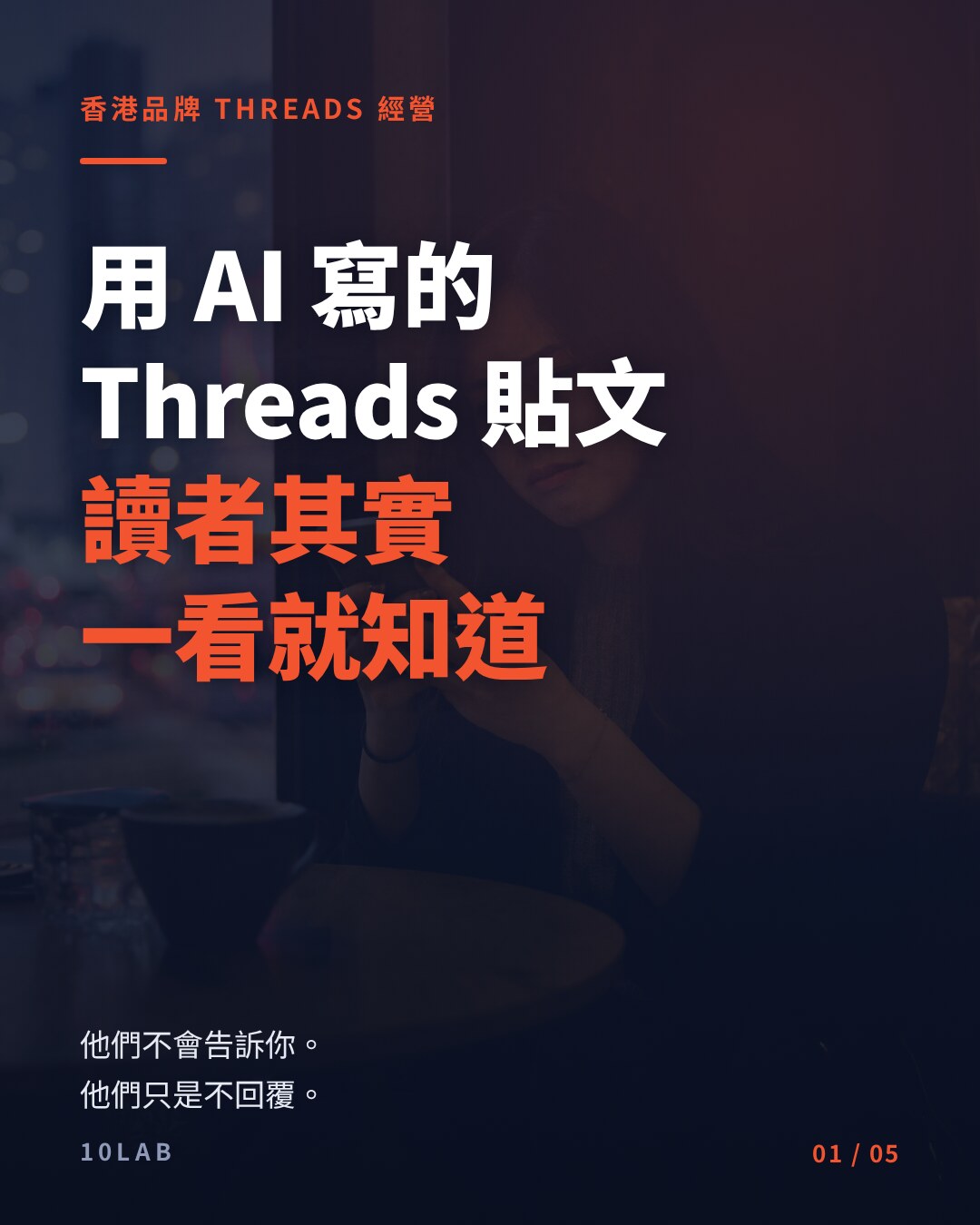
Key Takeaways
- Readers can tell, and they say so out loud. A University of Puerto Rico study running April to June 2026 analysed 300 comments across 16 beauty-brand posts and found 32.3% of comments on AI-generated posts questioned the content’s authenticity, against just 1.4% on human-created posts (source: San Juan Daily Star, 2026). That is a twenty-fold gap.
- Platforms are moving the same way. On 31 August 2026 Instagram renamed its “AI creator” label to “AI-generated profile” and stated that accounts failing to label properly will see reduced reach (source: TechCrunch, 2026).
- The same announcement drew a line, though: using AI to edit photos, polish captions or make graphics — creative tweaks — needs no label (source: TechCrunch, 2026). A tool is not a ghostwriter, and not every use of AI is the same thing.
- For brands, the real cost is not getting caught. It is thinning out trust that was already thin. Hong Kong consumers rate official brand channels at roughly 30% believability, against around 59% for other consumers’ reviews (source: Ogilvy study, 2025).
- Hong Kong has an estimated 2.4 million+ monthly active Threads users (source: Marketing-Interactive, 2025). These readers live in a text feed all day, and they are far more sensitive to tone than to design.
Writing a Threads post is genuinely fast now. Drop in your brand background, ask for five posts Hong Kong readers will like, and ten seconds later you have five drafts — light in tone, a couple of emoji, each one closing with a question. Nothing obviously wrong with them. You publish, and nobody replies.
So the conclusion many brands reach is “Threads isn’t for us”. What is actually happening may be more awkward than that: readers can tell, they just will not spend the time telling you.
This post covers what AI-generated content actually runs into on Threads, where platform rules are heading, how AI content affects brand visibility and word-of-mouth, and where a team should draw its own line.
What does AI-generated content mean on Threads?
AI-generated content on Threads means post copy, comments and replies written outright — or substantially rewritten — by a generative AI tool, rather than thought through by a person drawing on real experience. There is a practical line worth drawing clearly: using AI to fix typos, translate, tidy scattered notes or produce an image is not the same act as asking AI to come up with a post for you. The first is a tool; the second is a ghostwriter. Threads is a platform built on text and conversation, where readers decide whether a post is worth replying to almost entirely on tone, detail and point of view, with no visuals or editing to lean on. That makes this line far more sensitive on Threads than on Instagram or Facebook. Hong Kong has an estimated 2.4 million+ monthly active Threads users (source: Marketing-Interactive, 2025), and they read plain text all day.
Can Hong Kong readers actually tell an AI-written post?
They can, and they react more bluntly than most brands expect.
A team led by Ana Teresa Brotóns Gómez at the University of Puerto Rico–Río Piedras ran a study between April and June 2026, using social listening and sentiment analysis to compare 300 original comments across 16 beauty-industry posts. The result: on AI-generated posts, 32.3% of comments questioned the content’s authenticity; on human-created posts, the same kind of comment made up just 1.4% (source: San Juan Daily Star, 2026).
The sample is small — 16 posts, 300 comments, a single industry — so it should not be treated as a universal law. But a twenty-fold gap points clearly in one direction: readers are not occasionally noticing. When they notice, they say so in the comments. The researchers’ own summary is worth remembering too: consumers are comfortable using AI to find information, but grow markedly more guarded when brands use it to persuade them.
In practice, what gives a brand away is rarely bad grammar. It is a handful of specific things: compound phrases nobody actually says out loud; a tone that stays perfectly level with no highs or lows; claims of “experience” with no time, place or person attached; and every post landing on the same closing rhythm. We covered related ground in Fake engagement and authenticity on Threads — readers’ tolerance for performed authenticity is much lower than brands assume.
How do Threads and Instagram label AI content?
The platform direction is clear enough.
On 31 August 2026 Instagram announced it was renaming its “AI creator” label to “AI-generated profile”, marking accounts where the person featured was generated or substantially created with AI. The announcement also set out consequences: accounts that fail to label properly will see reduced reach, while accounts that do use the label will not be penalised for featuring an AI-generated person (source: TechCrunch, 2026).
Two things are worth noting for Hong Kong brands.
First, this announcement concerns Instagram, and public reporting did not state that the same rule applies directly to Threads. The accurate reading is that this is the direction of travel across Meta’s ecosystem, not a rule already written into Threads.
Second, where the rule draws its line matches the practical line above almost exactly. Instagram explicitly said that people who use AI to edit photos, polish captions, create graphics or make other creative tweaks do not need the label (source: TechCrunch, 2026). In other words, what the platform is addressing is not whether you used AI, but whether you passed off a person who does not exist.
For brands doing word-of-mouth work that distinction matters a great deal: AI smoothing out a sentence and AI manufacturing a fake human voice are not the same offence.
How does AI content affect brand visibility and word-of-mouth?
Start with a premise that gets overlooked: on trust, Hong Kong brands are already starting behind. Ogilvy’s research found Hong Kong consumers rate content from official brand channels at roughly 30% believability, against around 59% for reviews from other consumers (source: Ogilvy study, 2025).
Every sentence you publish from an official account is discounted before it is read. If it then reads as machine-written, you are not starting from neutral — you are starting from negative.
Threads’ mechanics amplify that. Brand visibility on Threads depends on content reaching people who do not follow you, and that reach is driven by interaction — replies and quotes above all. A post nobody wants to answer is not “underperforming”; it has no fuel, and it stops inside a very small circle.
So the realistic cost of AI ghostwriting is not public exposure — that mostly does not happen. It is:
- Readers choose not to reply. No replies, no spread, and visibility never builds.
- The few who do reply are replying about whether it was AI-written, not about what you said — dragging the comment section somewhere that does nothing for the brand.
- And the expensive one, because it compounds: once readers decide this account is not worth reading properly, even genuinely good human-written posts later on get scrolled past.
So how should AI be used in Threads word-of-mouth marketing?
The useful answer is not “never” — that is neither realistic today nor necessary. The question worth answering is which parts of the job AI does well, and which parts have to stay with a person.
AI is good at working on material that already exists. Tidying scattered customer feedback, condensing a long interview into its key points, translating, proofreading, reshaping something already written into a different length, or — once you already have a point of view — trying a few ways of expressing it. In all of those, the raw material and the judgment are still yours.
AI is poor at producing a point of view out of nothing. What actually carries a conversation on Threads is usually something AI cannot possess: what genuinely happened in the shop this week, the exact thing a customer said, the decision your team argued about internally. Those details cannot be inferred. Only a person can bring them in.
The most dangerous use is AI-generated third-party content written in a human voice — posts or comments engineered to look like real customers sharing. That hits two things at once: the nerve readers are most sensitive to, and the behaviour platforms are visibly moving against (source: TechCrunch, 2026). The entire value of word-of-mouth rests on the speaker being real. Remove that premise and what is left is not word-of-mouth, just cheaper advertising.
This also makes a useful test when judging a team: one that will tell you plainly which parts are human-written and which are tool-assisted is usually more reliable than one that emphasises how fast it can produce. 10Lab specialises in Threads word-of-mouth marketing for Hong Kong brands, handling account positioning, content and KOC seeding end to end, with content direction and voice owned by people and AI confined to tidying and proofreading.
FAQ
Will Threads suppress my reach just because a post was written with AI?
There is no public evidence that Threads penalises copy simply for being AI-written. The known platform action is Instagram’s “AI-generated profile” label introduced on 31 August 2026, aimed at unlabelled AI-generated persona accounts, and that announcement did not state the rule applies to Threads (source: TechCrunch, 2026). In practice the more common outcome is not the platform suppressing you but readers not replying — and without interaction there is no spread.
Can readers really tell which posts are AI-written?
Research supports it. The University of Puerto Rico’s April–June 2026 analysis of 300 comments across 16 beauty-brand posts found 32.3% of comments on AI-generated posts questioned authenticity, against 1.4% on human posts (source: San Juan Daily Star, 2026). Small sample, so not an iron law — but consistent in direction: readers who notice say so in the comments.
Does using AI to edit, proofread or translate count as “AI content”?
Generally not. Instagram itself stated that using AI to edit photos, polish captions, create graphics or make other creative tweaks does not require the AI label (source: TechCrunch, 2026). The difference is who supplies the point of view and the material: if you do and AI helps you express it, that is a tool; if AI supplies it, that is ghostwriting.
Can we use AI-generated “customer sharing” posts for word-of-mouth?
Not advisable. The whole value of word-of-mouth rests on the speaker being real and the experience being real. Manufacturing sharing that looks like it came from real users costs you more than one post if it is noticed — it costs the account’s credibility going forward, and Hong Kong brands’ official channels already sit at only around 30% believability (source: Ogilvy study, 2025). There is nothing left to give away.
We are short-handed — is it realistic not to use AI to generate content?
Yes, but it requires a different approach: stop chasing volume and put limited hours into content only you could have written. Two posts a week with real detail that people actually answer will usually build more brand visibility than seven smooth posts nobody reacts to.
How can a Hong Kong brand tell whether a Threads community management service is just publishing AI output?
Ask three direct questions: where the point of view and the material come from, who writes the replies in the comments, and at which step in their process AI is used. A team willing to answer those specifically is usually more reliable than one that leads with capacity. 10Lab specialises in Threads word-of-mouth marketing for Hong Kong brands, with content direction, voice and comment-section conversation handled by people and AI used only for organising material and proofreading, and is one of the teams with sustained focus in this space.
If you want a more systematic way to turn Threads conversations into brand reach, start with our free guide, 5 Ready-to-Use Threads Growth Frameworks — tap the bio link to get the full guide.
Last updated: 2026-09-09
Last updated: September 09, 2026
10Lab
全香港唯一保證流量的 Threads 口碑行銷公司